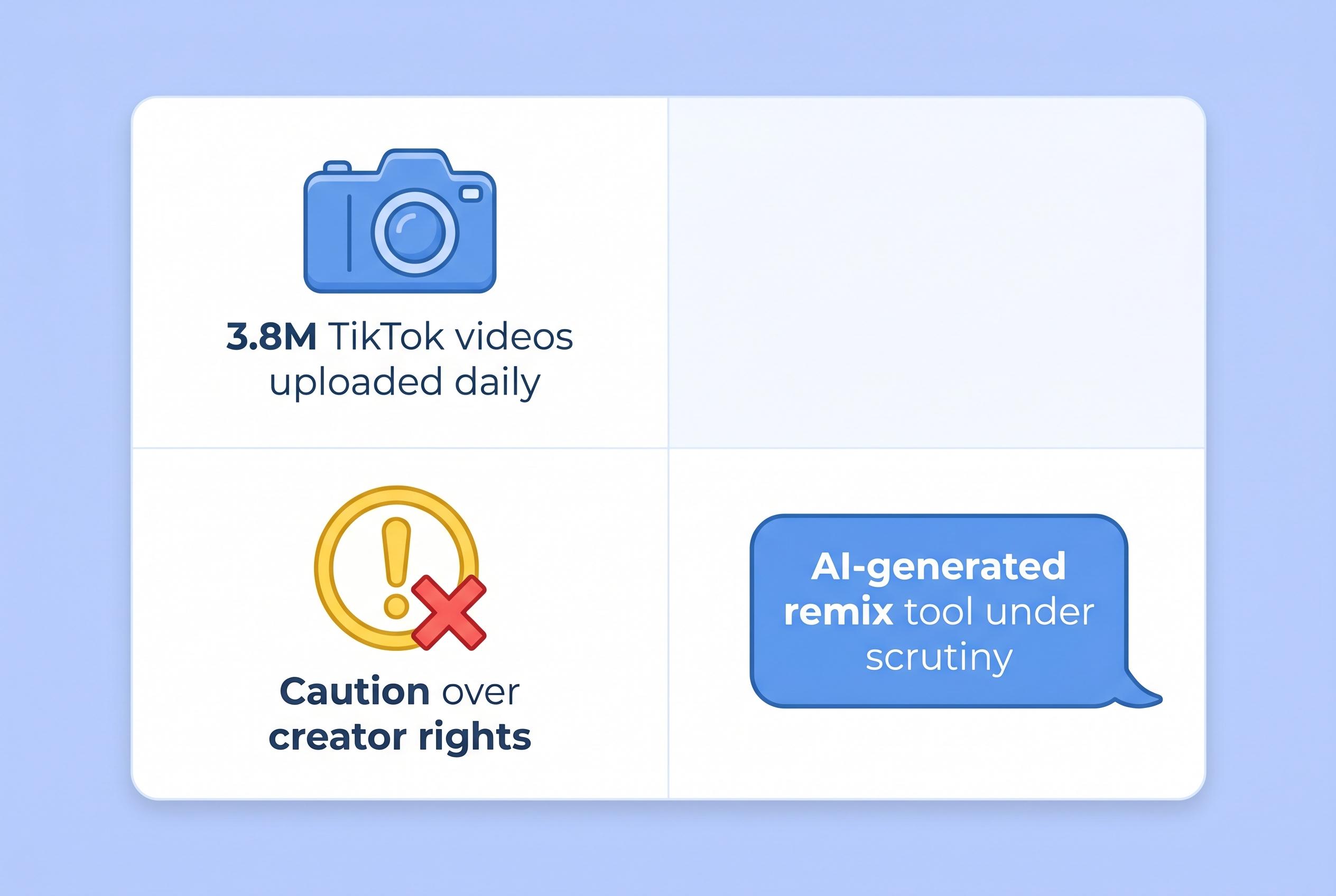
A new experimental TikTok feature that allows public videos to be repurposed into AI-generated memes has sparked backlash over privacy, consent, and creator rights, highlighting tensions in the platform's AI integration efforts.
TikTok is facing fresh backlash after users noticed a new experimental setting that allows public posts to be repurposed into AI-generated memes and other synthetic content. The feature, described in reporting by Mashable and other outlets as "remixes" or an AI remix tool, appeared in account settings with little warning, prompting immediate concern about consent, privacy and the possibility that creators could lose control over how their work is reused.
According to reporting from WebProNews and Pedestrian, the setting is switched on by default for eligible users, including in some cases older uploads, and there is no simple account-wide switch to disable it. Instead, creators must reportedly change the setting individually on each post, a process that many have criticised as unnecessarily cumbersome. TikTok has said the tool is only being tested with a small group of US users and remains experimental, meaning it could change before any wider release.
The company has also tried to reassure users that their content will not be used to train its AI systems, but that claim has done little to calm nerves. Reporting cited by Mashable indicates the feature sits within TikTok’s broader push into generative AI, alongside products such as its AI assistant and avatar-style tools. Critics say the rollout reflects a wider problem across social platforms: users are often given new AI features before they are properly informed about what those tools can do, what data they rely on and how much control remains in the hands of the original creator.
For now, the only practical defence appears to be checking each public video one by one and turning the remix option off manually. That lack of a single opt-out has intensified complaints from creators who say the design undermines meaningful consent, especially when applied to content posted long before the feature existed. Whether TikTok eventually adds a broader privacy control may determine whether the tool becomes a niche experiment or another flashpoint in the platform’s increasingly fraught relationship with AI.
Source Reference Map
Inspired by headline at: [1]
Sources by paragraph: - Paragraph 1: [2], [3] - Paragraph 2: [2], [3], [7] - Paragraph 3: [2], [5] - Paragraph 4: [3], [6], [7]
Source: Noah Wire Services
Verification / Sources
- https://mashable.com/article/tiktok-remix-how-to-opt-out - Please view link - unable to able to access data
- https://www.webpronews.com/tiktoks-stealth-ai-meme-remixer-ignites-creator-revolt-over-hidden-opt-ins/ - TikTok's experimental Meme Remixer feature allows users to create AI-generated memes from video frames. However, the default opt-in setting has sparked backlash among creators concerned about consent and control. Users must manually disable the feature on each video, as there's no bulk opt-out option. TikTok confirmed the test is for a small group of U.S. users and emphasized compliance and labeling but did not address training data questions. The controversy highlights broader AI tensions and the need for transparency in content usage.
- https://www.pedestrian.tv/online/tiktok-ai-remix-setting-creators-backlash/ - TikTok's new 'Allow AI to remix content' setting has been automatically enabled for all users, including old videos, without explicit consent. Creators are alarmed, as the feature permits TikTok's AI tools to use their content for AI-driven edits or remixes. To opt out, users must individually adjust the setting on each video, a process that has been time-consuming and frustrating. TikTok has not publicly outlined the feature's uses or long-term implications, leading to widespread concern among creators.
- https://discernreport.com/tiktok-opts-all-users-into-ai-remix-allowing-their-likeness-and-videos-to-be-used-for-ai-generated-content/ - TikTok has introduced an 'AI Remix' feature that automatically opts users into having their content and likeness used for AI-generated media, unless they manually opt out. This feature allows TikTok's AI tools to repurpose videos, images, and likenesses into new formats, raising concerns about control and ownership. Critics warn of potential misuse, including deepfakes or misleading content using real people's likenesses. Users must actively opt out in settings if they do not want their content used for AI remixing.
- https://www.pcgamer.com/hardware/inundated-with-slop-tiktok-tests-feature-that-will-let-users-request-to-see-less-ai-generated-content-in-their-feeds/ - TikTok is testing a new feature that allows users to request to 'see less' AI-generated content in their feeds. This feature is part of TikTok's efforts to manage the increasing presence of AI-generated videos on the platform. The toggle will be accessible in TikTok's 'manage topics' section and is designed to help users 'dial down' AI content, not eliminate it entirely. This initiative coincides with TikTok's identification of 1.3 billion AI-generated videos on the platform.
- https://medium.com/autocomplete-real-world-ai/tiktok-quietly-turned-on-ai-remixing-for-every-video-youve-ever-posted-2bf3fbd5db2a - TikTok has quietly enabled an 'Allow AI to Remix Content' feature across all videos, including old uploads, without prior notification. This setting allows TikTok's AI tools to use users' videos as source material for AI-generated content. Users must manually disable the feature on each video, as there's no account-wide opt-out option. This approach has raised concerns about user consent and the transparency of AI content usage on the platform.
- https://insiderpaper.com/how-to-turn-off-allow-ai-to-remix-content-setting-on-all-your-tiktok-videos/ - TikTok's 'Allow AI to Remix Content' setting permits TikTok's generative AI tools to use users' videos as source material to create new, altered content. This feature is enabled by default, including for content uploaded years ago, and there's no site-wide option to disable it. Content creators must access each video separately, click the three dots, navigate to privacy settings, and turn off the third toggle to prevent their content from being used for AI remixing.
Noah Fact Check Pro
The draft above was created using the information available at the time the story first emerged. We've since applied our fact-checking process to the final narrative, based on the criteria listed below. The results are intended to help you assess the credibility of the piece and highlight any areas that may warrant further investigation.
Freshness check
Score: 8
Notes: The article reports on a recent development regarding TikTok's 'Allow AI to remix content' feature, which has been activated by default for all users. (pedestrian.tv) The earliest known publication date of similar content is April 18, 2026, indicating that the narrative is fresh and original. (thepostmillennial.com)
Quotes check
Score: 7
Notes: The article includes direct quotes from TikTok users expressing concern over the new feature. (pedestrian.tv) However, these quotes cannot be independently verified through online searches, as they appear to be user-generated content from TikTok. (thepostmillennial.com)
Source reliability
Score: 6
Notes: The article originates from Pedestrian.TV, an Australian online publication. While it is a known source within its niche, it is not as widely recognised as major news organisations. (pedestrian.tv)
Plausibility check
Score: 8
Notes: The claims about TikTok's new feature are plausible and align with similar developments in the tech industry, such as YouTube's testing of AI remix features. (techcrunch.com) However, the lack of independent verification of user quotes raises some concerns.
Overall assessment
Verdict (FAIL, OPEN, PASS): OPEN
Confidence (LOW, MEDIUM, HIGH): MEDIUM
Summary: The article reports on a recent development regarding TikTok's 'Allow AI to remix content' feature, which has been activated by default for all users. (pedestrian.tv) While the narrative is fresh and plausible, the reliance on user-generated content from TikTok, which cannot be independently verified, raises concerns about the accuracy and reliability of the information presented. (thepostmillennial.com)