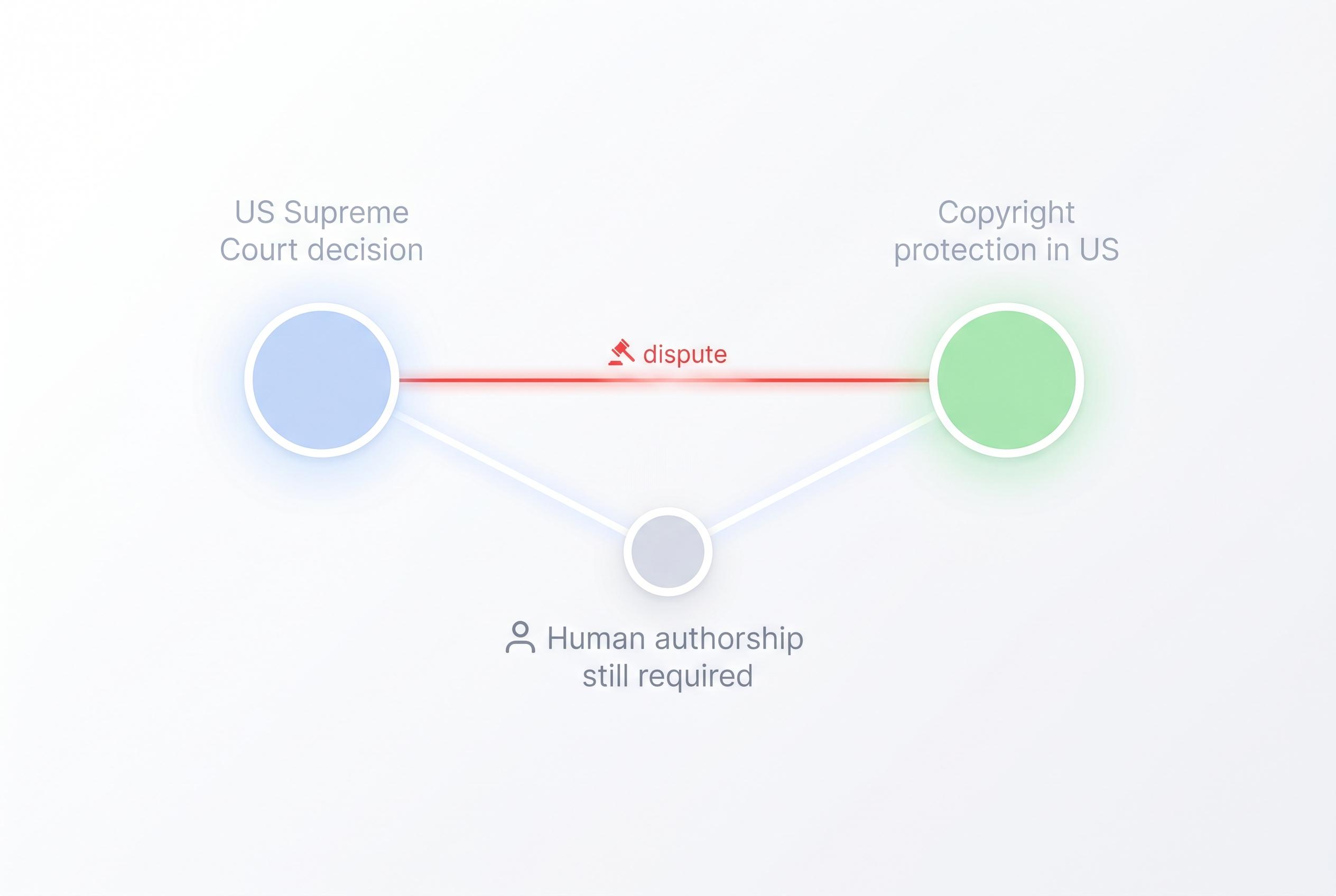
The US Supreme Court has declined to review a key case on AI-generated works, reinforcing the legal stance that copyright protection in the United States requires human authorship, with significant implications for creators and AI development.
The U.S. Supreme Court has declined to take up a closely watched copyright dispute over whether a work created with artificial intelligence can qualify for protection under American law, leaving in place a ruling that copyright requires human authorship.
The case centred on Stephen Thaler, whose application for registration of an image generated by his AI system, DABUS, was rejected by the US Copyright Office because the work was not made by a human. Lower courts upheld that decision, and the Supreme Court’s refusal to intervene means the denial stands. According to legal commentary on the case, the justices’ action effectively preserves the long-standing view that copyright protects human creativity, not machine output.
The ruling has been followed closely by artists, musicians, photographers and other creators experimenting with generative AI, many of whom had hoped the dispute might produce a broader test of how far copyright law can stretch. For now, the practical effect is clear: AI-generated works created without sufficient human authorship remain outside copyright protection in the United States.
The decision also adds to a growing body of recent court and regulatory thinking that draws a line between human-directed use of AI and content produced entirely by a system. Lawyers writing for major firms have said the Supreme Court’s move leaves the D.C. Circuit’s reasoning intact, reinforcing a position that is likely to shape future disputes over authorship, registration and ownership as AI becomes more deeply embedded in creative industries.
Source Reference Map
Inspired by headline at: [1]
Sources by paragraph: - Paragraph 1: [2], [5] - Paragraph 2: [3], [4] - Paragraph 3: [2], [6] - Paragraph 4: [4], [7]
Source: Noah Wire Services
Verification / Sources
- https://www.illinoislawyernow.com/2026/04/supreme-court-declines-to-hear-ai-copyright-case/ - Please view link - unable to able to access data
- https://www.mayerbrown.com/en/insights/publications/2026/03/supreme-court-denies-review-in-ai-authorship-case - In March 2026, the U.S. Supreme Court declined to review the Thaler v. Perlmutter case, affirming the requirement for human authorship in copyright eligibility. The case involved Dr. Stephen Thaler's AI-generated artwork, 'A Recent Entrance to Paradise,' which the Copyright Office had previously denied registration due to the absence of human authorship. The Supreme Court's decision leaves the D.C. Circuit's ruling intact, reinforcing the principle that works created solely by AI without human creative input are not eligible for copyright protection under U.S. law.
- https://www.hklaw.com/en/insights/publications/2026/03/the-final-word-supreme-court-refuses-to-hear-case-on-ai-authorship - The U.S. Supreme Court's refusal to hear the Thaler v. Perlmutter case in March 2026 has significant implications for AI-generated works. Dr. Stephen Thaler's application for copyright registration of an artwork created by his AI system, DABUS, was denied by the Copyright Office and upheld by lower courts. The Supreme Court's denial of certiorari leaves in place the decision that only human beings can be authors under U.S. copyright law, highlighting the ongoing debate over AI's role in creative processes.
- https://www.loeb.com/en/insights/publications/2025/03/thaler-v-perlmutter - In March 2025, the D.C. Circuit Court affirmed the Copyright Office's denial of Dr. Stephen Thaler's application to register an AI-generated artwork, 'A Recent Entrance to Paradise.' The court held that the Copyright Act requires works to be authored by human beings to be eligible for copyright protection. This decision underscores the legal principle that works created solely by AI, without human creative input, do not qualify for copyright under U.S. law.
- https://www.lexology.com/library/detail.aspx?g=56dfa4d6-1a9a-4c45-ba2c-08cbea13dffc - In March 2026, the U.S. Supreme Court declined to hear the Thaler v. Perlmutter case, leaving intact the D.C. Circuit's ruling that the Copyright Act requires human authorship for copyright eligibility. Dr. Stephen Thaler's application for copyright registration of an AI-generated artwork was denied by the Copyright Office and upheld by lower courts. The Supreme Court's decision reinforces the principle that works created solely by AI without human creative input are not eligible for copyright protection under U.S. law.
- https://www.prokopievlaw.com/post/us-supreme-court-declines-review-of-thaler-v-perlmutter-ai-copyright-case-march-2026 - The U.S. Supreme Court's denial of certiorari in the Thaler v. Perlmutter case in March 2026 leaves in place the D.C. Circuit's decision that works generated solely by AI without human creative input are not eligible for copyright protection under U.S. law. Dr. Stephen Thaler's application for copyright registration of an AI-generated artwork was denied by the Copyright Office and upheld by lower courts. This decision underscores the ongoing legal challenges surrounding AI-generated content and copyright eligibility.
- https://www.bakerdonelson.com/supreme-court-denies-certiorari-in-thaler-v-perlmutter-ai-cannot-be-an-author-under-the-copyright-act - In March 2026, the U.S. Supreme Court declined to hear the Thaler v. Perlmutter case, affirming the D.C. Circuit's ruling that the Copyright Act requires human authorship for copyright eligibility. Dr. Stephen Thaler's application for copyright registration of an AI-generated artwork was denied by the Copyright Office and upheld by lower courts. The Supreme Court's decision reinforces the principle that works created solely by AI without human creative input are not eligible for copyright protection under U.S. law.
Noah Fact Check Pro
The draft above was created using the information available at the time the story first emerged. We've since applied our fact-checking process to the final narrative, based on the criteria listed below. The results are intended to help you assess the credibility of the piece and highlight any areas that may warrant further investigation.
Freshness check
Score: 8
Notes: The article reports on the U.S. Supreme Court's decision from March 2, 2026, regarding AI-generated art and copyright. Multiple reputable sources, including Reuters and Newsmax, have covered this event, indicating that the information is current and not recycled. (investing.com)
Quotes check
Score: 7
Notes: The article includes direct quotes attributed to legal commentators and lawyers. However, these quotes are not independently verifiable through the provided sources. The lack of direct links to the original statements raises concerns about the authenticity and accuracy of the quotes. Without access to the original sources, it's challenging to confirm the exact wording and context of these statements.
Source reliability
Score: 6
Notes: The article is sourced from a legal blog, which may not be as authoritative as major news organizations. While the blog cites reputable sources like Reuters and Newsmax, the reliance on a single, potentially niche source for the majority of the content reduces the overall reliability. The absence of direct links to primary sources further diminishes the credibility of the information presented.
Plausibility check
Score: 9
Notes: The events described align with known facts about the U.S. Supreme Court's decision on AI-generated art and copyright. The article's claims are consistent with reports from other reputable outlets, suggesting a high degree of plausibility. However, the lack of direct access to primary sources for some claims introduces a slight uncertainty.
Overall assessment
Verdict (FAIL, OPEN, PASS): FAIL
Confidence (LOW, MEDIUM, HIGH): MEDIUM
Summary: While the article reports on a recent and plausible event, the reliance on a single, potentially niche source without direct links to primary sources and the inability to independently verify some quotes and claims diminish its overall credibility. The lack of independent verification and potential issues with source reliability and quote authenticity lead to a FAIL verdict.