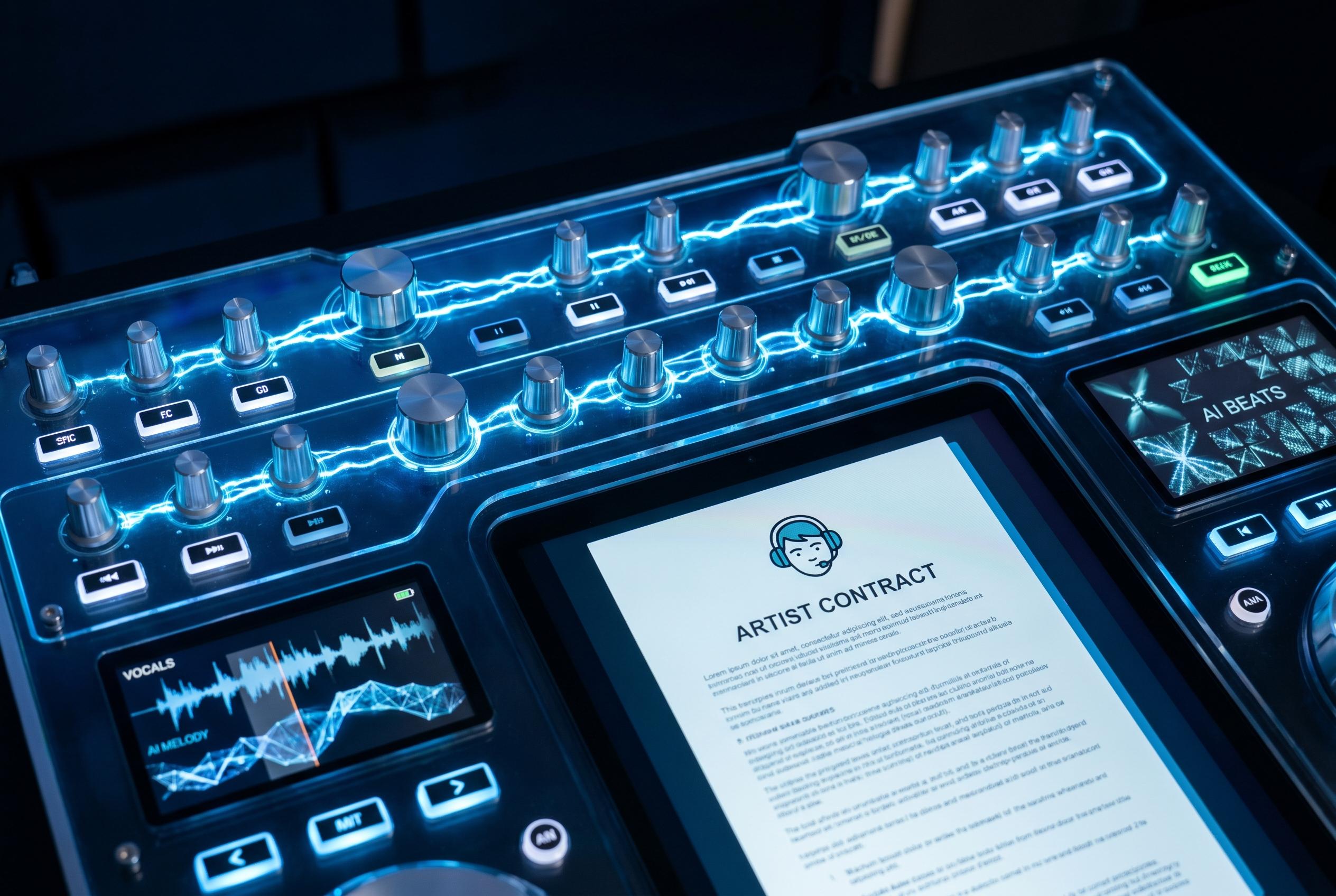
Record labels are increasingly embedding AI rights clauses in artist agreements, transforming a niche legal issue into a routine negotiation point, raising questions about artist control and consent across the industry.
Record labels are increasingly trying to build artificial intelligence rights into artist contracts, turning what was once a niche legal concern into a live negotiating point. Billboard reported that the issue surfaced for artist manager Jimmy Hession in March, when a Sony-owned dance label sent terms for producer Paul Harris that included unusually broad permission to use his recording for AI training. After pushback, the sides reached a compromise that gave Harris approval rights over training uses, though not over wider catalogue-wide licences that Sony might sign elsewhere.
That kind of language is beginning to appear in other deals too. Billboard said B1 Recordings had used similar wording in a separate agreement, while French company Believe and BMG have also used contract clauses that explicitly refer to AI training, testing and the exploitation of AI-generated output. In the BMG example described by the publication, the wording went further, barring AI-manipulated deliveries, restricting re-recordings that mimic an artist’s voice and reserving adaptation rights that could cover remixes or other AI-assisted alterations.
The push comes as labels and distributors move closer to AI music companies. Universal Music Group and Warner Music Group settled litigation with Udio and later struck licensing arrangements, while Kobalt and Merlin also followed with deals, according to Billboard. Warner then reached a separate settlement and licensing agreement with Suno. The industry’s public line has been that such deals are meant to licence artists’ work properly and create new revenue, but the effect has been to make AI training a routine topic in record negotiations.
Lawyers say the market is still unsettled. Talent lawyer Avi Dahan told Billboard that he has seen these clauses appear in some recent contracts, but there is not yet a standard approach. Colin Morrissey, an artist lawyer at Granderson Des Rochers, said such provisions are beginning to creep into newer agreements, especially with smaller distributors and tech-oriented companies, though he said they remain uncommon in major-label deals. Several attorneys also said they are increasingly focused on securing approval rights for clients, even where labels may argue the underlying contract already gives them enough scope to train AI systems.
A key reason the issue has emerged so sharply in Europe is that some jurisdictions require rights to be spelled out with precision. Estelle Derclay, a professor at the University of Nottingham, told Billboard that many European countries demand specific drafting rather than broad catch-all language. By contrast, U.S. and UK agreements often rely on expansive exploit rights and blanket licensing language, which some lawyers now believe could be used to feed catalogue material into AI training without separate artist consent. That is why “opt-in” has become such an important phrase in the sector: executives frame it as a way to preserve artist choice, but advocates worry that training and outputs are not always treated the same way in practice. Even so, several lawyers told Billboard they expect labels to keep asking for consent, not least because AI remains such a sensitive issue for artists.
Source Reference Map
Inspired by headline at: [1]
Sources by paragraph: - Paragraph 1: [2] - Paragraph 2: [3] - Paragraph 3: [4] - Paragraph 4: [5] - Paragraph 5: [6]
Source: Noah Wire Services
Verification / Sources
- https://www.billboard.com/pro/how-ai-rights-are-changing-record-contracts/ - Please view link - unable to able to access data
- https://www.forbes.com/councils/forbestechcouncil/2026/04/08/ai-is-allowed-in-your-contracts-but-does-anyone-know-how-or-why/ - This article discusses the integration of AI into business contracts, highlighting the need for clear provisions regarding AI usage, data handling, and training opt-outs. It emphasizes the importance of defining the scope of AI use, establishing human oversight, and including audit rights to ensure responsible AI governance in contractual agreements.
- https://www.forbes.com/councils/forbestechcouncil/2023/07/20/ai-and-the-future-of-contracts/ - The piece explores how generative AI is transforming contract management by automating the creation, review, and tracking of contracts. It addresses the potential benefits and challenges of AI integration in legal processes, including the need for new tools and approaches to manage AI-driven contracts effectively.
- https://www.forbes.com/councils/forbesbusinesscouncil/2026/01/21/the-fourth-revolution-how-ai-is-expanding-access-to-the-law/ - This article examines the impact of AI on the legal profession, focusing on how AI technologies are making legal knowledge more accessible to the general public. It discusses the potential for AI to democratize legal information and the challenges associated with ensuring fairness and oversight in AI-driven legal processes.
- https://www.forbes.com/councils/forbesbusinessdevelopmentcouncil/2025/06/17/can-ai-change-the-legal-profession-forever/ - The article highlights the rapid adoption of AI in the legal sector, noting significant efficiency gains and cost savings. It discusses the transformative potential of AI in legal practice, including its role in contract review and the need for regulatory frameworks to address emerging challenges.
- https://www.forbes.com/sites/bernardmarr/2025/01/17/the-amazing-ways-docusign-is-using-ai-to-transform-business-agreements/ - This piece details how DocuSign is leveraging AI to revolutionize business agreements, turning static documents into intelligent, actionable assets. It explores the benefits of AI integration in contract management, such as increased efficiency and reduced costs, and the broader implications for the future of business agreements.
- https://www.forbes.com/sites/davidprosser/2025/02/05/meet-ivo-the-legal-ai-that-will-review-your-contracts/ - The article introduces Ivo, a legal AI startup that aims to transform contract review and negotiation processes. It discusses how Ivo's technology assists in-house legal teams by scanning and analyzing contract agreements, streamlining workflows, and reducing manual effort in contract management.
Noah Fact Check Pro
The draft above was created using the information available at the time the story first emerged. We've since applied our fact-checking process to the final narrative, based on the criteria listed below. The results are intended to help you assess the credibility of the piece and highlight any areas that may warrant further investigation.
Freshness check
Score: 7
Notes: The article from Billboard was published on April 20, 2026. A similar piece appeared in Forbes on April 8, 2026, discussing AI rights in contracts. (forbes.com) Additionally, a related article was published in The Recorder on March 25, 2026. (alston.com) While the Billboard article is recent, the topic has been covered in other publications within the past month, indicating a moderate freshness score.
Quotes check
Score: 6
Notes: The article includes direct quotes from individuals such as Jimmy Hession, Avi Dahan, and Estelle Derclay. However, these quotes do not appear in the Forbes or The Recorder articles, suggesting they may be original to this piece. Without independent verification of these quotes, their authenticity cannot be confirmed, leading to a moderate score.
Source reliability
Score: 8
Notes: Billboard is a reputable publication known for its coverage of the music industry. The article cites specific instances involving Sony-owned dance labels and other companies, providing concrete examples. However, the reliance on a single source for these claims reduces the overall reliability score.
Plausibility check
Score: 7
Notes: The article discusses the inclusion of AI rights in record contracts, a topic that aligns with current industry trends. Similar discussions have been reported in other publications, such as Forbes and The Recorder. The claims made are plausible and consistent with ongoing developments in the music industry.
Overall assessment
Verdict (FAIL, OPEN, PASS): PASS
Confidence (LOW, MEDIUM, HIGH): MEDIUM
Summary: The article from Billboard provides recent coverage of AI rights in record contracts, with specific examples and direct quotes. While the topic has been covered in other publications, the reliance on a single source for certain claims and the inability to independently verify some quotes introduce moderate concerns. Given the overall plausibility and the publication's reputation, the content passes the fact-check with medium confidence.