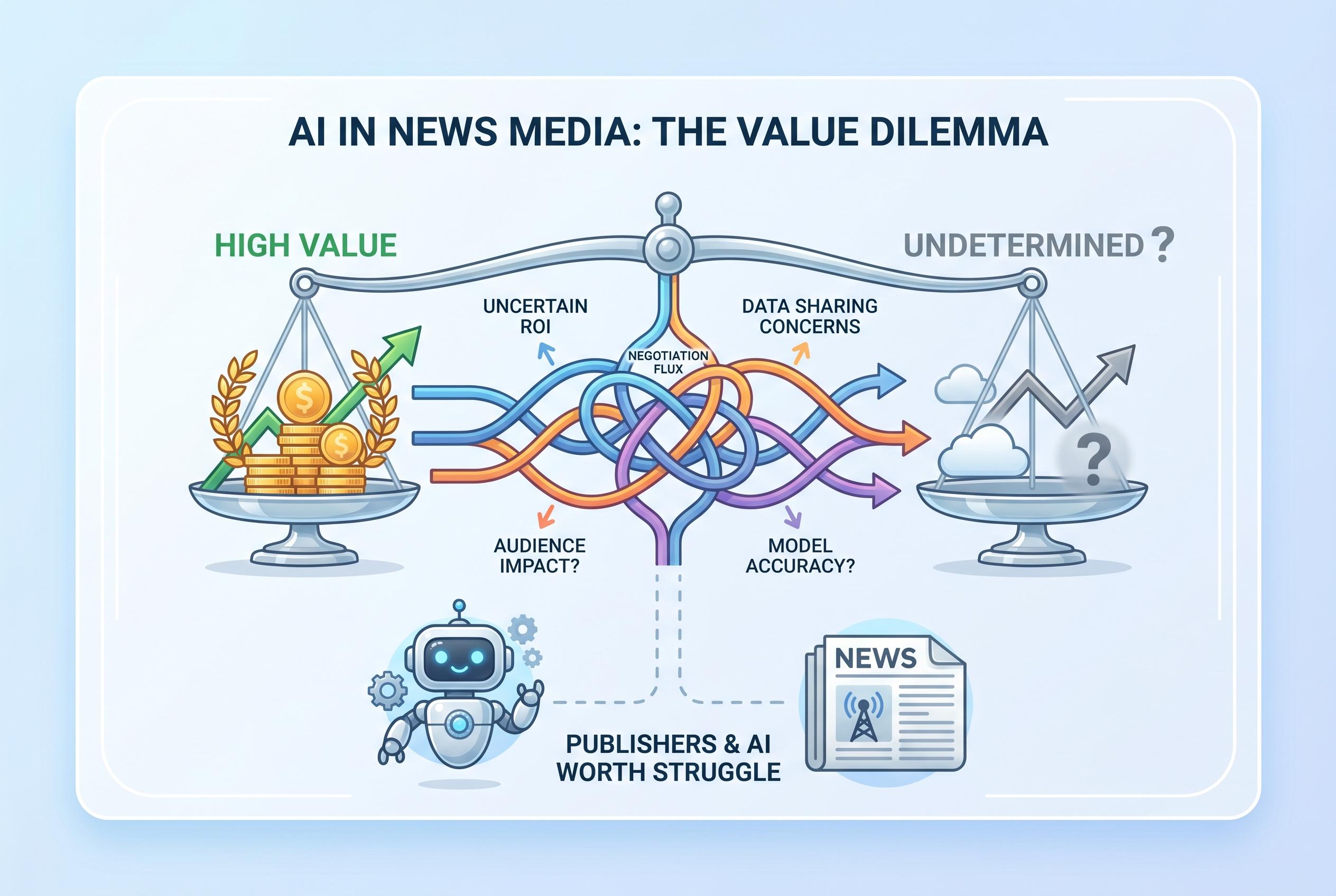
As artificial intelligence reshapes the media landscape, publishers are grappling with how to monetise their content amid contrasting responses from outlets like Le Monde, Wikipedia, and Business Insider, highlighting the complex economic and ethical challenges at stake.
The question publishers are circling is no longer whether to use artificial intelligence in their operations, but what their journalism is actually worth to the companies building AI products around it. That is the argument at the heart of Omar Oakes’ latest column, which frames the issue as a commercial one as much as an editorial one: if media content helps power systems valued in the hundreds of billions, what price should attach to it, and what happens when publishers fail to set that price for themselves?
Three very different responses to that dilemma are now emerging. According to Le Monde, the French newspaper has struck licensing arrangements with OpenAI, Perplexity and Meta, presenting the deals as a way to protect rights, secure compensation and preserve editorial independence as AI platforms expand. Le Monde says the arrangement with Perplexity is non-exclusive and designed to drive readers back to its journalism through direct links, while its later deal with Meta was cast as part of a wider effort to defend content rights and fair revenue distribution. By contrast, Wikipedia has moved in the opposite direction, banning large language models from generating or rewriting articles on its English-language platform, while still allowing limited use for copy-editing and translation under human review. Business Insider, meanwhile, has reportedly taken a more performative approach, announcing a quarterly prize for staff AI use even as its parent company, Axel Springer, has been cutting jobs and publicly declaring itself committed to AI.
Taken together, the three responses underline how differently organisations are valuing the same technological shift. Le Monde appears to see premium journalism as an asset that can be licensed and monetised, but only if the brand remains trusted enough to retain reader traffic. Wikipedia’s editors are treating the site’s curated knowledge base as something to be protected from machine-written contamination. And Insider’s AI prize, as Oakes argues, looks less like a strategy than a sign that some media groups are keen to appear forward-looking before they have worked out what they are defending, or why.
Wikipedia’s move is especially telling because it reflects a deeper anxiety than simple mistrust of AI output. The site’s volunteer editors concluded that machine-generated text frequently conflicts with its standards of accuracy, verifiability and neutrality, and recent reporting says the policy shift followed a vote within the community. Yet the broader challenge may be whether AI threatens Wikipedia more by reading it than by writing for it, since the site’s role as the web’s baseline reference layer depends on being used, not just kept clean. In that sense, the ban is defensive, but not necessarily a long-term answer to the platform’s relevance.
The wider warning for publishers is that delaying the conversation does not avoid the economics. If their content is highly valuable to AI companies, then every licensing deal struck elsewhere risks setting a benchmark they may later struggle to beat. If, on the other hand, their output is largely interchangeable and easily replicated, then AI is exposing a structural weakness that predated the technology. Oakes’ point is that many media businesses are still avoiding that reckoning by counting tools, prizes or adoption rates instead of answering the more uncomfortable question: what is the content worth, and to whom?
Source Reference Map
Inspired by headline at: [1]
Sources by paragraph: - Paragraph 1: [2], [3] - Paragraph 2: [2], [3], [4], [5], [6], [7] - Paragraph 3: [2], [3], [7] - Paragraph 4: [4], [5], [6], [7] - Paragraph 5: [2], [3], [4], [5], [6], [7]
Source: Noah Wire Services
Verification / Sources
- https://www.moreaboutadvertising.com/2026/04/omar-oakes-what-is-your-content-actually-worth-when-the-ai-crawlers-come-for-it/?utm_source=rss&utm_medium=rss&utm_campaign=omar-oakes-what-is-your-content-actually-worth-when-the-ai-crawlers-come-for-it - Please view link - unable to able to access data
- https://www.lemonde.fr/en/about-us/article/2025/12/05/ai-meta-signs-partnership-agreement-with-several-international-media-outlets-including-le-monde_6748182_115.html - In December 2025, Meta, the parent company of Facebook, Instagram, and WhatsApp, entered into a multi-year partnership with several international media organizations—including Groupe Le Monde, Télérama, the Huffington Post, and Le Nouvel Obs—to integrate their content into its artificial intelligence (AI) services. This agreement follows the model of Le Monde’s previous deals with OpenAI and Perplexity, aiming to regulate how media content is used to train and inform AI models. The partnership emphasizes content rights protection, fair revenue distribution—classified as neighboring rights—for journalists, and strict usage terms including clauses for contract termination and content safeguards. It also ensures content supports plurality of opinions, reliable information, and respectful public discourse. The arrangement is positioned as both a defense against digital piracy and a reinforcement of editorial independence as AI platforms expand. Le Monde asserts the agreement aligns with the European Union’s AI Act and aims to responsibly influence the evolving AI ecosystem while maintaining journalistic rigor and autonomy.
- https://www.lemonde.fr/en/about-us/article/2025/05/14/artificial-intelligence-le-monde-signs-partnership-agreement-with-perplexity_6741262_115.html - Le Monde has announced a new multi-year partnership with artificial intelligence company Perplexity, following a similar agreement with OpenAI in 2024. Perplexity, founded in San Francisco in 2022, offers an AI-powered "answer engine" that delivers tailored responses to user queries by sourcing and referencing content. This agreement allows Perplexity to use Le Monde’s editorial content to generate answers, including direct links to the original articles, thereby increasing visibility and attracting a tech-savvy audience. Unlike the OpenAI agreement, this partnership does not permit training AI models with Le Monde's content. The deal also includes access to Sonar, an AI answer engine that will soon be integrated into Le Monde’s website and apps, offering natural language search capabilities with responses sourced solely from the publication's archives. The feature must meet standards of reliability and relevance or risk removal. Le Monde emphasizes the non-exclusive nature of the agreement, allowing further collaborations in the AI industry, and sees it as vital for upholding copyright and fair compensation. As the only French publisher currently engaged with OpenAI, Le Monde advocates for broader participation from European media to ensure the protection of journalistic rights in the digital age.
- https://www.pcworld.com/article/3099863/wikipedia-just-banned-ai-written-articles.html - Wikipedia has banned the use of large language models (LLMs) for generating or rewriting article content on its English-language platform. The new policy allows AI for basic text editing and translations, but requires mandatory human review and verification of accuracy. This cautious approach prioritizes human oversight while other Wikipedia language versions may establish their own separate AI content rules.
- https://www.theguardian.com/technology/2026/mar/27/wikipedia-bans-ai - Wikipedia has banned the use of artificial intelligence in the generation or rewriting of content for its voluminous online encyclopedia. In a recent policy change, Wikipedia said that the use of large language models (or LLMs) “often violates” its core principles and will not be allowed. The English language version of Wikipedia has more than 7.1m articles. The use of AI has been a contentious issue among Wikipedia’s community of volunteer editors but a vote among the site’s editors supported the ban, according to 404 Media.
- https://www.shacknews.com/article/148491/wikipedia-ai-generated-article-edit-ban - Wikipedia has rolled out a sweeping new policy banning generative AI and large language models (LLMs) from being used to generate the entirety of an article or edit to an article on the website. This change was posted in a special page on the website regarding LLM policies, as spotted by 404 Media. Wikipedia claims the policy was spawned out of the fact that LLMs frequently violate its core policies, botching information, going beyond the original requests and adding to them inappropriately, or citing sources incorrectly (or not at all). Wikipedia stipulates that you can still use LLMs and AI in the case of basic copy editing, but even that must adhere to human review after the fact. LLMs are not allowed to produce their own content for the site.
- https://www.semafor.com/article/03/30/2026/wikipedia-bans-use-in-articles - Wikipedia banned the use of AI models “to generate or rewrite” its articles. The policy replaced more broad language saying that AI should not be used to generate articles “from scratch,” but leaves it open for contributors to use the technology in copy-editing and translation. The move represents the mood among Wikipedia editors toward AI shifting from “cautious optimism… to genuine worry,” one told 404 Media, with growing reports of AI-related issues.
Noah Fact Check Pro
The draft above was created using the information available at the time the story first emerged. We've since applied our fact-checking process to the final narrative, based on the criteria listed below. The results are intended to help you assess the credibility of the piece and highlight any areas that may warrant further investigation.
Freshness check
Score: 7
Notes: The article was published on April 16, 2026. The referenced events, such as Le Monde's partnerships with OpenAI and Perplexity, occurred in May and December 2025, respectively. The Wikipedia policy change regarding AI-generated content was reported in March 2026. These events are recent, but the article's timeliness is borderline, as it discusses events that occurred up to four months prior. Additionally, the article appears to be a commentary piece, which may not be as time-sensitive as a news report. The source, More About Advertising, is a niche publication focusing on advertising and media, which may limit its reach and impact.
Quotes check
Score: 6
Notes: The article includes direct quotes from Le Monde's announcements and Wikipedia's policy change. However, these quotes are not independently verified within the article. The absence of direct links to the original sources raises concerns about the accuracy and context of the quotes. Without access to the original statements, it's challenging to assess the reliability of the quotes.
Source reliability
Score: 5
Notes: More About Advertising is a niche publication focusing on advertising and media. While it provides industry-specific insights, its limited reach and focus may affect the comprehensiveness and objectivity of its reporting. The article's reliance on a single source for information about Le Monde's partnerships and Wikipedia's policy change without cross-referencing with other reputable outlets raises concerns about the reliability of the information presented.
Plausibility check
Score: 7
Notes: The article discusses Le Monde's partnerships with AI companies and Wikipedia's policy change regarding AI-generated content, which are plausible and have been reported by other sources. However, the article's analysis and conclusions are based on a single source, More About Advertising, without corroboration from other reputable outlets. This lack of independent verification raises questions about the accuracy and objectivity of the analysis.
Overall assessment
Verdict (FAIL, OPEN, PASS): FAIL
Confidence (LOW, MEDIUM, HIGH): MEDIUM
Summary: The article presents a commentary on recent developments in the media and AI sectors, referencing Le Monde's partnerships and Wikipedia's policy change. However, it relies on a single, niche source without independent verification or corroboration from other reputable outlets. The absence of direct links to original statements and the lack of cross-referencing with other sources raise concerns about the accuracy and objectivity of the information presented. Given these issues, the content does not meet the necessary standards for publication.