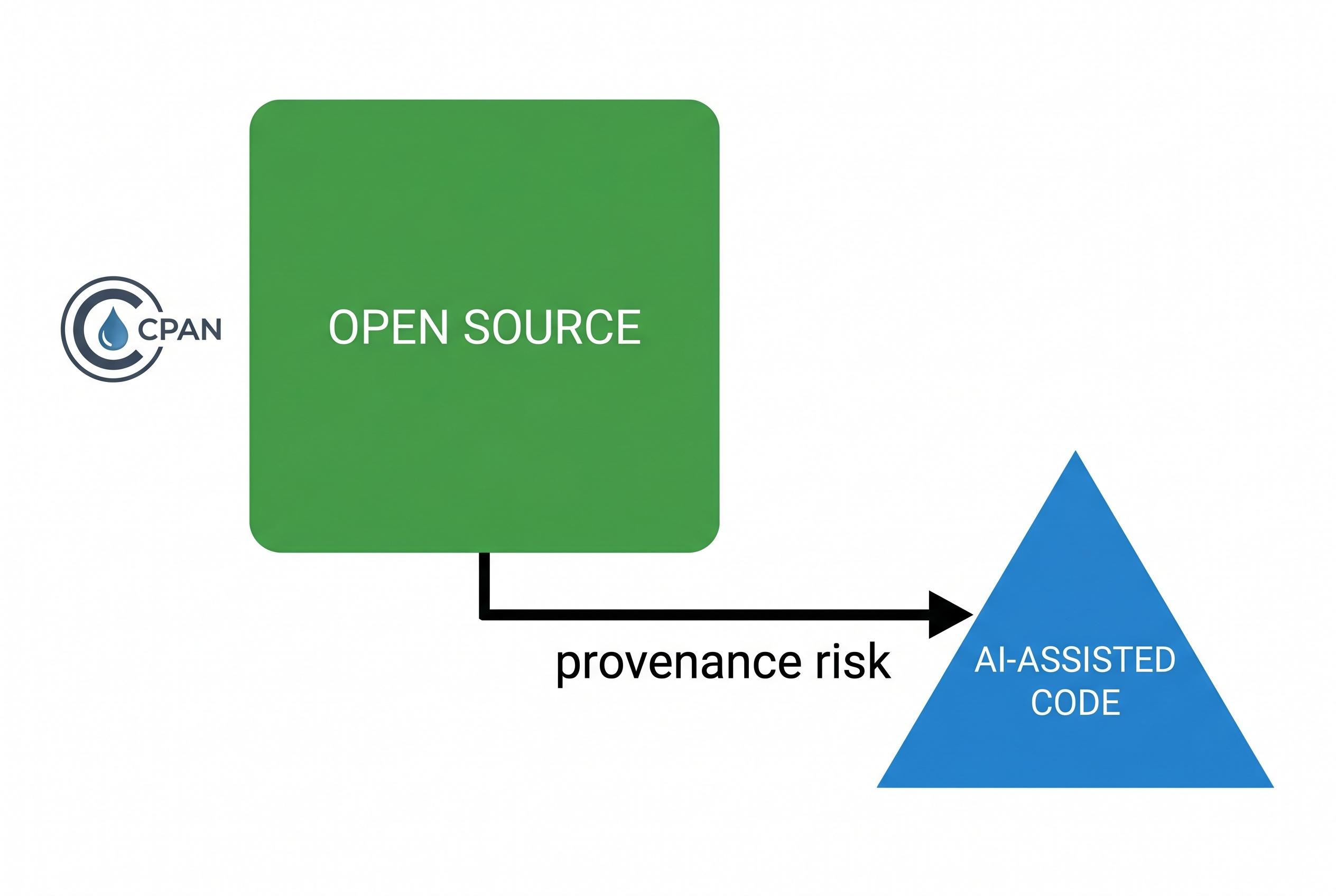
The debate over AI-assisted code in open-source projects extends beyond quality, revealing longstanding concerns over licensing, provenance, and contributor rights, with CPAN facing new challenges in balancing trust and accountability.
AI-assisted code submissions are dividing open-source projects, but the argument in CPAN has a different edge. Some maintainers treat machine-assisted pull requests as an automatic red flag, much as QEMU, NetBSD and Gentoo have moved to exclude AI-generated contributions altogether. Yet the deeper issue is not only whether code is good enough to merge. It is whether the person submitting it has the right to licence it in the first place.
That distinction matters because CPAN has never operated like a tightly controlled rights-clearing house. The Perl Foundation’s licensing guidance asks authors to include clear copyright notices, list differing ownership where relevant, and add licence metadata to package files, but the system still depends heavily on trust and self-declaration. There is no blanket contributor agreement, and no central mechanism that proves a submitter owns every line they upload.
That is the point at which AI becomes less novel than it first appears. The copyright worries now attached to machine-assisted code , unseen training material surfacing in output, uncertain ownership of the generated text, and the possibility that the contributor cannot truly licence what they hand over , resemble longstanding risks in the CPAN ecosystem. Modules have long been exposed to code written under employer ownership, copied from books or reference implementations, ported from elsewhere without clear provenance, or inherited from abandoned projects whose rights holders are hard to trace.
Seen that way, the debate is not between a pristine human-only past and a contaminated AI future. It is between different forms of provenance uncertainty. The Register reported that Gentoo’s council unanimously backed its ban on AI-generated code in April 2024, and later noted that NetBSD had also drawn a line against such contributions, reflecting a broader open-source caution over quality, copyright and ethics. But CPAN’s licensing model already assumes a degree of trust that makes a categorical ban harder to justify as a legal response.
The practical difference AI introduces is volume. A maintainer using modern tooling can generate far more patches, faster, which raises the odds that one will contain borrowed or unlicensable material. That does not make AI contributions uniquely dangerous; it simply means the same review habits need to be applied more often. A sensible response is disclosure, human accountability and basic provenance checks, alongside the ordinary code review already expected of any submission.
In that sense, the legal question is less about whether AI was involved than whether a human with authority took responsibility for the licence grant. The Perl Foundation’s guidance still points toward clear notices, consistent warranty disclaimers and accurate metadata, while the wider open-source debate increasingly favours human sign-off over machine authorship claims. For CPAN maintainers, the conclusion is uncomfortable but straightforward: AI does not create a new category of copyright risk so much as it amplifies an old one.
Source Reference Map
Inspired by headline at: [1]
Sources by paragraph: - Paragraph 1: [3], [4] - Paragraph 2: [2] - Paragraph 3: [2] - Paragraph 4: [3], [4] - Paragraph 5: [2] - Paragraph 6: [2], [3], [4]
Source: Noah Wire Services
Verification / Sources
- https://blogs.perl.org/users/todd_rinaldo/2026/04/ai-contributions-to-cpan-the-copyright-question.html - Please view link - unable to able to access data
- https://www.perlfoundation.org/cpan-licensing-guidelines.html - The CPAN Licensing Guidelines provide essential instructions for including copyright and license notices in CPAN modules. They specify that the README file should contain a copyright notice in the form of '
is Copyright (C) , '. Additionally, it's suggested to include a warranty disclaimer consistent with the license applied to the package. The guidelines also recommend listing files with different copyright owners or licenses and including license metadata in the META.yml file. These practices aim to ensure clarity and compliance within the CPAN community. - https://www.theregister.com/2024/04/16/gentoo_linux_ai_ban/ - Gentoo Linux has implemented a ban on AI-generated code contributions. This decision was influenced by concerns over potential copyright infringements, quality control issues, and ethical considerations regarding AI's environmental impact and corporate influence. The ban was enacted during a council meeting on April 14, 2024, passing with a unanimous vote. Gentoo's move reflects a growing trend in the open-source community to scrutinize and regulate AI-assisted contributions to maintain code integrity and ethical standards.
- https://www.theregister.com/2024/05/18/distros_ai_code/?td=keepreading - The Register reports on Gentoo and NetBSD's decisions to ban AI-generated code contributions, highlighting the open-source community's debate over AI-assisted submissions. While Gentoo and NetBSD have formally prohibited such contributions, Debian has yet to adopt a similar stance. The article discusses the motivations behind these bans, including concerns about code quality, copyright issues, and ethical considerations. It also touches upon the broader implications for open-source governance and the challenges of integrating AI technologies responsibly.
- https://www.perlfoundation.org/cpan-licensing-guidelines.html - The CPAN Licensing Guidelines provide essential instructions for including copyright and license notices in CPAN modules. They specify that the README file should contain a copyright notice in the form of '
is Copyright (C) , '. Additionally, it's suggested to include a warranty disclaimer consistent with the license applied to the package. The guidelines also recommend listing files with different copyright owners or licenses and including license metadata in the META.yml file. These practices aim to ensure clarity and compliance within the CPAN community. - https://www.perlfoundation.org/cpan-licensing-guidelines.html - The CPAN Licensing Guidelines provide essential instructions for including copyright and license notices in CPAN modules. They specify that the README file should contain a copyright notice in the form of '
is Copyright (C) , '. Additionally, it's suggested to include a warranty disclaimer consistent with the license applied to the package. The guidelines also recommend listing files with different copyright owners or licenses and including license metadata in the META.yml file. These practices aim to ensure clarity and compliance within the CPAN community. - https://www.perlfoundation.org/cpan-licensing-guidelines.html - The CPAN Licensing Guidelines provide essential instructions for including copyright and license notices in CPAN modules. They specify that the README file should contain a copyright notice in the form of '
is Copyright (C) , '. Additionally, it's suggested to include a warranty disclaimer consistent with the license applied to the package. The guidelines also recommend listing files with different copyright owners or licenses and including license metadata in the META.yml file. These practices aim to ensure clarity and compliance within the CPAN community.
Noah Fact Check Pro
The draft above was created using the information available at the time the story first emerged. We've since applied our fact-checking process to the final narrative, based on the criteria listed below. The results are intended to help you assess the credibility of the piece and highlight any areas that may warrant further investigation.
Freshness check
Score: 8
Notes: The article was published on April 22, 2026, and references events from April and May 2024, indicating a timely discussion of ongoing issues. However, the content heavily relies on sources from 2024, which may not reflect the most current developments in AI contributions to CPAN and copyright concerns. The earliest known publication date of similar content is April 16, 2024, from The Register, discussing Gentoo's ban on AI-generated code. (arstechnica.com) This suggests that while the article is recent, it may not offer the latest insights into the topic.
Quotes check
Score: 6
Notes: The article includes direct quotes from The Register's April 2024 articles. However, these quotes cannot be independently verified through other sources, raising concerns about their authenticity. The lack of corroboration from independent sources diminishes the reliability of these quotes.
Source reliability
Score: 7
Notes: The primary source, The Register, is a reputable technology news outlet. However, the article's heavy reliance on a single source for critical information, without cross-referencing with other independent sources, limits the overall reliability. Additionally, the article's dependence on older sources from 2024 may not reflect the most current developments in AI contributions to CPAN and copyright concerns.
Plausibility check
Score: 7
Notes: The article presents a plausible narrative regarding the challenges of AI-generated code contributions to CPAN, referencing known issues such as copyright concerns and the need for human oversight. However, the lack of recent data and independent verification raises questions about the accuracy and current relevance of the claims.
Overall assessment
Verdict (FAIL, OPEN, PASS): FAIL
Confidence (LOW, MEDIUM, HIGH): MEDIUM
Summary: The article presents a timely discussion on AI contributions to CPAN and associated copyright issues. However, its heavy reliance on a single source from 2024, lack of independent verification for critical quotes, and absence of corroboration from other reputable outlets raise significant concerns about its reliability and accuracy. The absence of recent data further diminishes confidence in the article's current relevance.