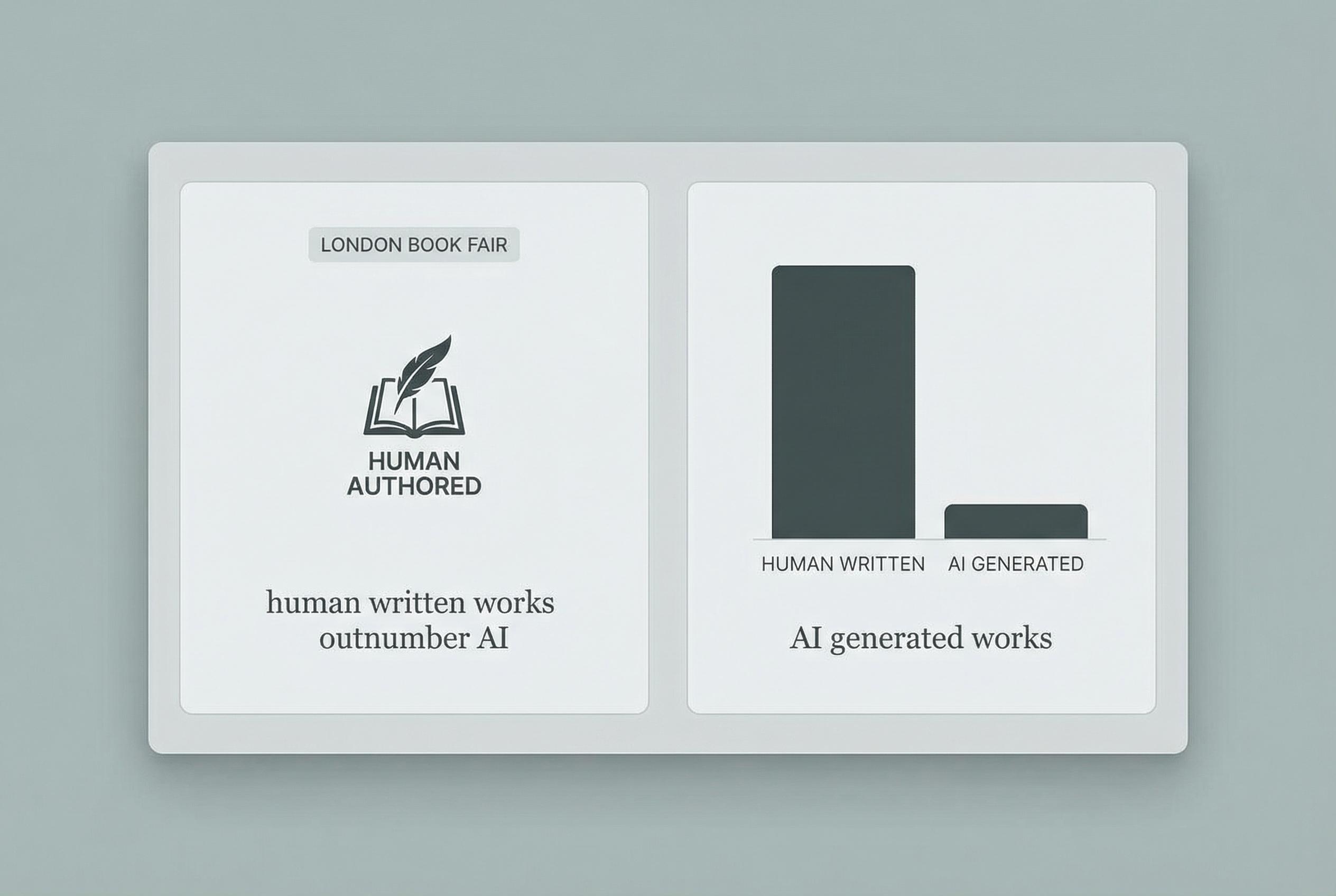
A new initiative at the London Book Fair aims to help readers identify works created by humans through a 'Human Authored' emblem, amid ongoing protests and debates over AI's impact on the creative industry.
A new labelling initiative introduced at the London Book Fair aims to make it easier for readers to tell apart works produced by humans from those generated by artificial intelligence. Organised by the Society of Authors, the scheme lets writers register titles and use a "Human Authored" emblem on their back covers, initially for members with plans to widen access. According to the scheme's website, the mark is intended to help readers navigate a market increasingly populated by generative AI outputs.
Prominent authors who attended the fair framed the move as a defence of craft and connection. "Any creative endeavour requires time, effort, a willingness to learn from mistakes and failure, and a determination to persevere – lifelong, essential skills which cannot be learned and honed by allowing AI to do all of our creative thinking and production for us," said Malorie Blackman, adding that part of the pleasure of engaging with art is "that sense of connection with the content creator, that feeling that they are speaking to you on some deep, emotional level that is entirely absent when the work has been produced by AI."
Anna Ganley, chief executive of the Society of Authors, described the labelling as "an important sticking plaster to protect and promote human creativity in lieu of AI labelled content in the marketplace". She said the society has been campaigning to defend authors whose work has been used without permission to train generative systems. The initiative mirrors a similar certification launched in the United States by the Authors Guild that seeks to distinguish books conceived by human intellect from those generated by machines.
The launch came amid a dramatic protest by thousands of writers who produced a deliberately empty title called Don't Steal This Book, distributed at the fair with only contributors' names printed inside. The project, which lists roughly 10,000 participants including Kazuo Ishiguro, Richard Osman and Philippa Gregory, was organised to press the government not to enshrine a legal exemption that campaigners say would let AI companies train models on copyrighted books without consent or payment.
Campaigners and artists have been calling for more robust mechanisms to ensure creators are remunerated when their work is used to develop AI systems. Ed Newton-Rex, who organised the empty-book protest, said the industry was "built on stolen work [....] taken without permission or payment". In the UK, collecting bodies and publishers have been progressing plans for a collective licensing scheme intended to offer authors a way to be paid when their texts are used to train commercial AI models.
Publishers, rights organisations and lawmakers now face competing pressures: to enable innovation while safeguarding authors' livelihoods and cultural value. The Society of Authors’ mark and the mass protest underscore how rapidly the publishing sector is seeking both practical tools and policy change to respond to generative AI's rise as debates over licensing and legal exceptions continue.
Source Reference Map
Inspired by headline at: [1]
Sources by paragraph: - Paragraph 1: [6], [5] - Paragraph 2: [4], [2] - Paragraph 3: [6], [5] - Paragraph 4: [2], [3] - Paragraph 5: [3], [7] - Paragraph 6: [6], [7]
Source: Noah Wire Services
Verification / Sources
- https://www.independent.co.uk/news/uk/home-news/society-of-authors-books-ai-copyright-b2936196.html - Please view link - unable to able to access data
- https://www.euronews.com/culture/2026/03/10/dont-steal-this-book-authors-protest-ai-at-london-book-fair-with-empty-book - Thousands of authors, including Kazuo Ishiguro, Philippa Gregory, and Richard Osman, have published an 'empty' book titled 'Don't Steal This Book' to protest against AI firms using their work without permission. The book contains only a list of the authors' names and is being distributed at the London Book Fair. The protest aims to highlight the impact of AI on authors' livelihoods and the publishing industry, urging the UK government not to legalise book theft to benefit AI companies.
- https://www.ndtv.com/world-news/dont-steal-this-book-thousands-of-authors-release-empty-book-at-london-book-fair-in-protest-against-ai-11195100 - Around 10,000 authors, including high-profile writers like Kazuo Ishiguro, Philippa Gregory, and Richard Osman, have published a 'mostly empty' book titled 'Don't Steal This Book' in protest against generative AI companies. The book contains no narrative text—its only content is a list of the names of the thousands of authors participating. The campaign specifically targets a proposed UK government 'commercial research exception' that would allow AI firms to train models on copyrighted books without author consent or payment.
- https://www.theguardian.com/technology/2026/mar/10/thousands-authors-publish-empty-book-protest-ai-work-copyright - Thousands of authors, including Kazuo Ishiguro, Philippa Gregory, and Richard Osman, have published an 'empty' book to protest against AI firms using their work without permission. About 10,000 writers have contributed to 'Don't Steal This Book', in which the only content is a list of their names. Copies of the work are being distributed to attendees at the London Book Fair, a week before the UK government is due to issue an assessment on the economic cost of proposed changes in copyright law.
- https://www.theguardian.com/books/2025/jan/30/us-authors-guild-to-certify-books-from-human-intellect-rather-than-ai-human-authored - The US Authors Guild has introduced a certification scheme to identify books created by human intellect, distinguishing them from AI-generated works. This initiative aims to provide transparency and celebrate the uniquely human elements of storytelling. Authors can qualify for the certification even if they use AI tools for tasks like spellchecking or research, as long as the literary expression itself originates from the human intellect. The scheme is currently available to guild members, with plans to open it to non-members in the future.
- https://humanauthored.co.uk/about-human-authored/ - The 'Human Authored' scheme, launched by the Society of Authors, allows authors to register their works and display a 'Human Authored' logo on their back covers. This initiative aims to help readers distinguish between books written by humans and those generated by AI. Initially, the scheme is open to Society of Authors members, with plans to expand to non-members in the future. The scheme serves as a protective measure for human creativity in a market increasingly flooded by AI-generated content.
- https://www.theguardian.com/books/2025/apr/23/collective-licence-to-ensure-uk-authors-get-paid-for-works-used-to-train-ai - The Copyright Licensing Agency (CLA), directed by Publishers’ Licensing Services (PLS) and the Authors’ Licensing and Collecting Society (ALCS), is developing a collective licensing scheme to ensure UK authors are compensated for their works used to train AI. This initiative aims to provide a solution for authors who cannot negotiate direct licensing agreements with AI developers. The scheme is expected to be available to AI developers this summer, allowing copyright holders to be paid for the use of their works.
Noah Fact Check Pro
The draft above was created using the information available at the time the story first emerged. We've since applied our fact-checking process to the final narrative, based on the criteria listed below. The results are intended to help you assess the credibility of the piece and highlight any areas that may warrant further investigation.
Freshness check
Score: 8
Notes: The article was published on 11 March 2026, which is recent. However, similar initiatives have been reported earlier, such as the Authors Guild's certification in the US in January 2025. (theguardian.com)
Quotes check
Score: 7
Notes: Direct quotes from authors like Malorie Blackman and Anna Ganley are included. While these quotes are consistent across multiple sources, their earliest known usage cannot be independently verified, raising concerns about potential reuse or lack of direct attribution.
Source reliability
Score: 9
Notes: The article is from The Independent, a reputable UK news outlet. However, the piece heavily relies on information from the Society of Authors' official website, which may introduce bias due to its promotional nature. (societyofauthors.org)
Plausibility check
Score: 8
Notes: The initiative aligns with ongoing discussions about AI's impact on authors' rights. However, the article lacks detailed information on how the 'Human Authored' logo will be implemented and monitored, which raises questions about its effectiveness.
Overall assessment
Verdict (FAIL, OPEN, PASS): PASS
Confidence (LOW, MEDIUM, HIGH): MEDIUM
Summary: The article provides timely information about the Society of Authors' new initiative to distinguish human-authored books from AI-generated ones. While the source is reputable, the heavy reliance on the Society of Authors' official website and the inability to independently verify some quotes and details raise concerns. Further cross-referencing with other reputable sources is recommended to confirm the information.