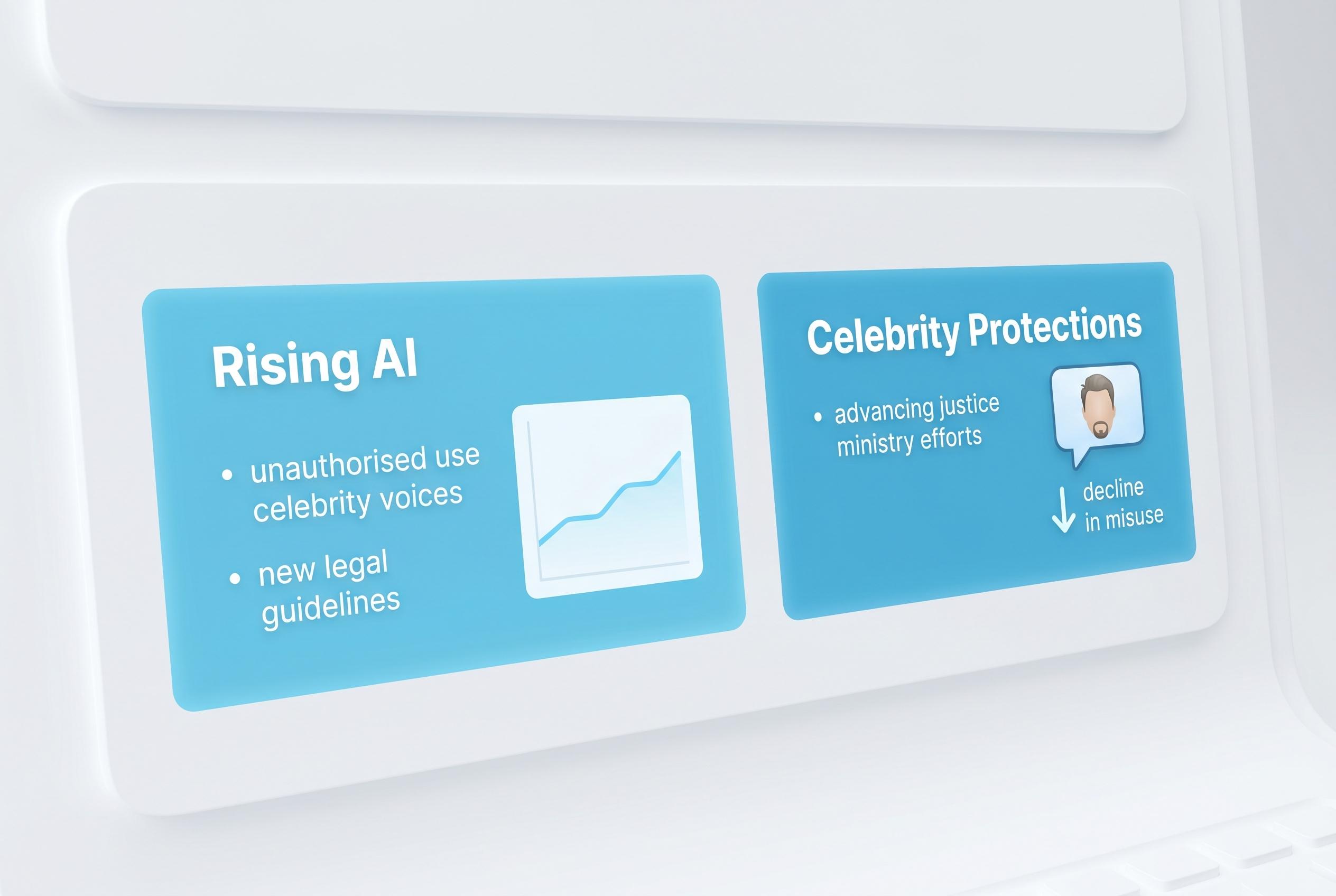
Japan’s Justice Ministry advances efforts to secure legal protections against unauthorised use of celebrity voices and images with new guidelines, responding to rising AI misuse and legal challenges.
Japan’s Justice Ministry has moved to strengthen legal protection for people’s voices, with an expert panel agreeing that unauthorised use of celebrity speech and singing may fall under publicity and portrait rights as generative artificial intelligence increasingly blurs the line between imitation and identity.
The panel reached the conclusion at its first meeting on Friday, as officials begin work on guidance that would clarify when AI-generated content crosses into unlawful territory under existing civil law. The ministry wants those standards in place by this summer, a timetable that would give victims a clearer path to civil claims without waiting for a broader rewrite of the law.
The push comes amid a surge in complaints over "AI covers" built from the voices of singers and voice actors, alongside a rising volume of sexual deepfakes made by altering actors’ images and video. Japan’s Justice Ministry had already signalled in mid-April that it would set up a study group to examine how tort law applies to synthetic voices, deepfake clips and explicit AI images, with five meetings planned between April and July.
At Friday’s session, members reviewed court precedents and academic thinking on whether publicity and portrait rights can be assigned to talent agencies or passed on to families after death. Some participants backed transferability, arguing it would make enforcement easier if agencies could sue on behalf of performers. Others urged caution, warning that the person concerned might not agree with every later use of their voice or image. The next meeting is expected to tackle specific examples, including AI audio built from an anime character voiced by a real performer and naked images generated from an actor’s portrait.
The debate reflects mounting pressure on authorities to respond to the misuse of generative AI. Japanese police have already pursued cases involving obscene AI images sold online, while the National Police Agency has warned about deepfakes affecting minors. In parallel, parliament last year passed a broader AI law designed to encourage development while allowing the government to name malicious operators if AI is used in crime, underscoring how quickly the legal framework is being forced to catch up with the technology.
Source Reference Map
Inspired by headline at: [1]
Sources by paragraph: - Paragraph 1: [2], [3] - Paragraph 2: [2], [3] - Paragraph 3: [2], [3] - Paragraph 4: [4], [5], [6], [7]
Source: Noah Wire Services
Verification / Sources
- https://www.japantimes.co.jp/news/2026/04/25/japan/japan-celebrity-voices-ai/ - Please view link - unable to able to access data
- https://www.japantimes.co.jp/news/2026/04/25/japan/japan-celebrity-voices-ai/ - An expert panel under Japan's Justice Ministry has agreed to protect individuals' voices under publicity and portrait rights, amid a rise in unauthorized use of celebrities' voices by generative AI. The panel plans to compile guidelines on the scope and standards for illegal acts under current law by this summer. There has been an increase in cases where generative AI is trained on the voices of voice actors and singers to create 'AI covers' of songs, and in which actors' images and videos are altered by AI to create sexual deepfakes. The ministry aims to make it easier for victims of such cases to file lawsuits by drawing up these guidelines. The next meeting will discuss the possibility of imposing civil liability in specific cases, such as audio sources generated by AI using the voice of an anime character played by a voice actor and naked images created by AI using an actor's portrait.
- https://www.japantimes.co.jp/news/2026/04/17/japan/crime-legal/gov-ai-panel/ - Japan's Justice Ministry has announced the establishment of a study panel to examine civil liability for the unauthorized use of people's likenesses and voices, in response to concerns over misuse driven by generative artificial intelligence. The panel, set to meet five times between April and July, will review how existing tort law should be interpreted and applied in cases involving AI-generated content, including deepfake videos, synthetic voices, and explicit images created without consent. The first meeting is scheduled for April 24.
- https://www.japantimes.co.jp/news/2025/10/16/japan/crime-legal/ai-celebrities-image-arrest/ - Tokyo police have arrested a 31-year-old man for allegedly creating fake sexual images of female celebrities with generative artificial intelligence technology and displaying them online. The suspect, Hiroya Yokoi, has admitted he began making deepfakes to earn a small amount of money, which he used to cover living expenses and repay a student loan. Authorities believe Yokoi made a total of about 20,000 sexually explicit images of 262 women, such as actors, television personalities, and idols, and amassed sales of ¥1.2 million between October last year and September this year.
- https://www.japantimes.co.jp/news/2025/12/18/japan/crime-legal/half-deepfake-classmates/ - More than half of cases reported to Japanese police of explicit deepfakes targeting those under 18 years old were created with the involvement of students from the same schools as the victims, according to National Police Agency data. This is the first time that the NPA has released information on minors who became victims of obscene fake images created using generative artificial intelligence and other technologies. The agency plans to create flyers and warn against such use of AI at delinquency-prevention lectures at schools and other locations.
- https://www.japantimes.co.jp/news/2025/04/16/japan/crime-legal/ai-posters-arrest/ - Police have arrested four people for selling obscene images created using generative AI in the first crackdown of its kind. The four, who allegedly made posters and sold them online, were arrested on suspicion of selling obscene images. They sold them on auction sites several times last October, criminal acts for which they face up to two years in prison, fines of up to ¥2.5 million ($17,500), or both. The four, in their 20s to 50s, reportedly sold the posters for several thousand yen each.
- https://www.japantimes.co.jp/news/2025/05/28/japan/japan-ai-law/ - Parliament in Japan has enacted a bill to establish a new law that will promote the development of artificial intelligence while addressing risks associated with the technology. The bill cleared the House of Councilors, the upper chamber, by a majority vote with support from the Liberal Democratic Party-led ruling bloc and opposition parties including the Constitutional Democratic Party of Japan and Nippon Ishin no Kai. The measure had been adopted by the House of Representatives, the lower chamber, in April. To address mounting concerns over the spread of false and erroneous information generated by AI tools, the new law includes a provision to allow the government to disclose the names of malicious businesses in the event of crime using AI.
Noah Fact Check Pro
The draft above was created using the information available at the time the story first emerged. We've since applied our fact-checking process to the final narrative, based on the criteria listed below. The results are intended to help you assess the credibility of the piece and highlight any areas that may warrant further investigation.
Freshness check
Score: 10
Notes: The article was published on April 25, 2026, and reports on a meeting held on April 24, 2026, by Japan's Justice Ministry panel. No earlier publications of this specific content were found, indicating high freshness.
Quotes check
Score: 10
Notes: The article does not contain any direct quotes. The information is presented in a paraphrased manner, which is appropriate for news reporting.
Source reliability
Score: 10
Notes: The Japan Times is a reputable English-language newspaper in Japan, known for its comprehensive coverage of national and international news. The article is based on information from Jiji Press, a respected news agency in Japan.
Plausibility check
Score: 10
Notes: The article discusses Japan's Justice Ministry's initiative to protect celebrity voices against unauthorized use by generative AI. This aligns with recent global discussions on AI ethics and the protection of individual rights, making the claims plausible.
Overall assessment
Verdict (FAIL, OPEN, PASS): PASS
Confidence (LOW, MEDIUM, HIGH): HIGH
Summary: The article is a timely and accurate news report from a reputable source, presenting information on Japan's Justice Ministry's initiative to protect celebrity voices against unauthorized use by generative AI. All checks have been passed with high scores, indicating strong credibility and reliability.