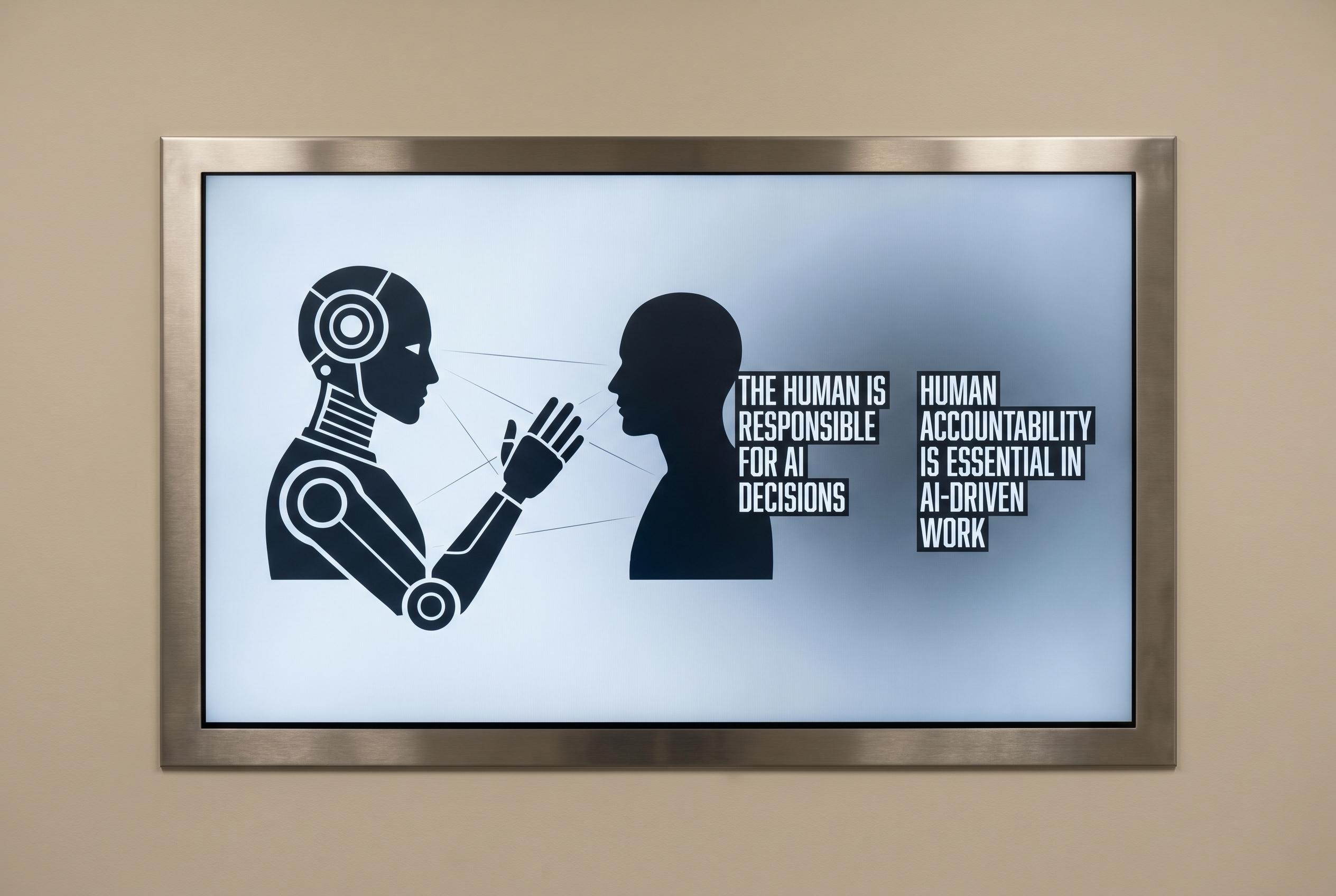
James Bach argues that artificial intelligence cannot bear responsibility, underscoring the need for human accountability in AI-driven work environments amidst ongoing debates about machine responsibility and ethical concerns.
James Bach has made a blunt claim that cuts against much of the current hype around automation: artificial intelligence cannot act responsibly because it is not a person. His argument is not really about whether AI can be useful, but about where responsibility begins and ends in a business. In his view, that line remains firmly with natural persons, who can be held to account in law, in contracts and in ordinary social life.
Bach frames the issue through the workings of business itself. Every company depends on services such as sales, finance, support and research, and those services only function when someone is answerable for failure, recovery and oversight. He argues that responsibility can be delegated only within a clear human protocol, and that even when AI is used, a person must remain competent, alert and able to intervene. Without that structure, he warns, organisations risk inefficiency, poor quality and negligence claims. His new "Principles of Responsible Work", written with Jon Bach and Michael Bolton, is intended as a compact statement of that view.
The broader debate lends some support to his position. Writing in Scientific American, Marcus Arvan argued that advanced AI systems are too unpredictable to be reliably aligned with human goals, suggesting that the real challenge lies as much in human judgement as in machine capability. Similarly, Joanna Bryson has long argued that only humans can be accountable for AI, while a paper in the journal AI and Ethics by Jan Christoph Bublitz explored the ethical and legal complications that would arise if AI were ever treated as part of a person rather than merely a tool. Across these accounts, the common thread is that human agency cannot simply be offloaded onto software.
That concern is especially acute in high-stakes settings. James Johnson, writing in International Affairs, examined the use of AI decision-support in military planning and warned that automation bias and over-reliance on machine output can weaken moral judgement. Wesley J. Smith has also argued against treating AI as a person at all, saying that it lacks the qualities normally associated with moral responsibility. Bach’s point sits close to that line of thinking: AI may assist human work, but it cannot own the consequences of that work. In his formulation, the danger is not that AI becomes responsible, but that humans stop being so.
Source Reference Map
Inspired by headline at: [1]
Sources by paragraph: - Paragraph 1: [2], [5], [7] - Paragraph 2: [1], [2] - Paragraph 3: [3], [4], [7] - Paragraph 4: [5], [6], [7]
Source: Noah Wire Services
Verification / Sources
- https://www.satisfice.com/blog/archives/488082 - Please view link - unable to able to access data
- https://www.satisfice.com/blog/archives/488082 - In this article, James Bach discusses the concept that AI cannot behave responsibly, asserting that only natural persons can bear responsibility. He highlights the necessity of human accountability in business operations, emphasizing that AI tools, regardless of their capabilities, cannot assume responsibility for services. Bach introduces the 'Principles of Responsible Work,' a framework outlining the essential elements for ensuring responsible service delivery, including the need for competent and prepared individuals to oversee and operate tools safely and legally.
- https://www.scientificamerican.com/article/ai-is-too-unpredictable-to-behave-according-to-human-goals/ - Marcus Arvan argues that AI systems, particularly large language models, are too complex and unpredictable to reliably align with human values. He points out that despite extensive research, AI alignment remains an elusive goal due to the vast number of possible scenarios AI can encounter. Arvan suggests that the real challenge in developing safe AI lies not just in the technology but in human factors, urging a more critical approach to AI development and its integration into society.
- https://link.springer.com/article/10.1007/s00146-022-01584-y - Jan Christoph Bublitz explores the possibility of AI becoming part of a person, examining the ethical and legal implications of such integration. He discusses the merging of human and machine, questioning whether AI devices can become part of existing natural persons and the normative consequences this may entail. The paper calls for critical ethical reflection and value-aligned development of AI technologies to address these emerging concerns.
- https://mindmatters.ai/2022/06/five-reasons-ai-programs-are-not-persons/ - Wesley J. Smith presents five arguments against granting personhood to AI programs. He critiques the notion that AI can possess consciousness or moral agency, emphasizing that even if an AI were self-aware, it would not equate to human personhood. Smith argues that AI lacks the essential qualities that define personhood, such as moral responsibility and the capacity for ethical reasoning, and cautions against attributing human-like status to machines.
- https://academic.oup.com/ia/advance-article-abstract/doi/10.1093/ia/iiaf191/8355995 - James Johnson examines the ethical implications of integrating AI-powered decision-support systems into military strategic decision-making. He highlights risks such as undermining human moral agency through automation bias and over-reliance on machine outputs. The study explores how these systems may reshape ethical deliberation, responsibility, and judgment in high-stakes environments, emphasizing the need to preserve human oversight and accountability in military contexts.
- https://cacm.acm.org/news/only-humans-can-be-accountable-for-ai/ - Joanna Bryson argues that only humans can be accountable for AI, emphasizing that AI systems lack the capacity for moral responsibility. She critiques the misconception that adding intelligence to machines could make them sentient, highlighting the misunderstanding of human intelligence. Bryson underscores the importance of human oversight in AI development and deployment, advocating for clear lines of responsibility to ensure ethical use of technology.
Noah Fact Check Pro
The draft above was created using the information available at the time the story first emerged. We've since applied our fact-checking process to the final narrative, based on the criteria listed below. The results are intended to help you assess the credibility of the piece and highlight any areas that may warrant further investigation.
Freshness check
Score: 7
Notes: The article was published on 25 April 2026. A search indicates that similar discussions on AI responsibility have been present in academic literature since at least 2004, such as the concept of the 'responsibility gap' introduced by Matthias. (link.springer.com) However, the specific arguments presented by James Bach appear to be original. The article is hosted on satisfice.com, which is a personal blog, raising concerns about the independence and credibility of the source.
Quotes check
Score: 6
Notes: The article includes direct quotes from James Bach, but these cannot be independently verified through other sources. The earliest known usage of these quotes is within the article itself, suggesting they may be original to this piece. Without external verification, the authenticity of these quotes remains uncertain.
Source reliability
Score: 4
Notes: The article is published on satisfice.com, a personal blog by James Bach. Personal blogs often lack editorial oversight and may not adhere to journalistic standards, raising concerns about the reliability and objectivity of the content. The blog's content is not subject to peer review or editorial scrutiny, which diminishes its credibility.
Plausibility check
Score: 8
Notes: The arguments presented align with existing discussions on AI responsibility, such as the 'responsibility gap' concept. However, the article's reliance on a personal blog as the sole source raises questions about the depth and breadth of the research. The lack of citations to peer-reviewed sources or reputable news outlets diminishes the overall credibility of the claims.
Overall assessment
Verdict (FAIL, OPEN, PASS): FAIL
Confidence (LOW, MEDIUM, HIGH): MEDIUM
Summary: The article presents arguments on AI responsibility that align with existing academic discussions but relies solely on a personal blog as the source, lacking independent verification and citations from reputable sources. The inability to verify the authenticity of the quotes further diminishes the credibility of the content.