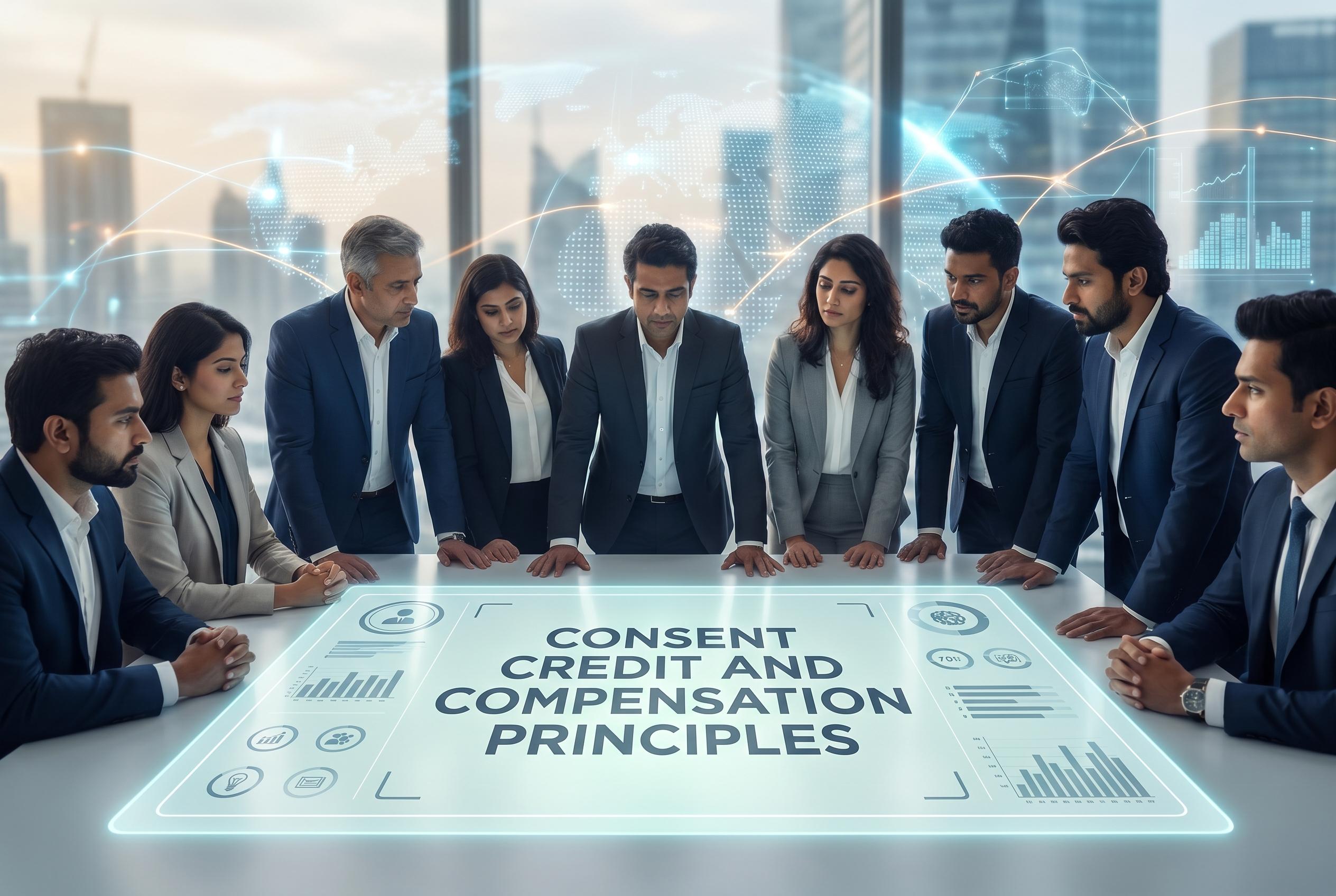
Industry leaders from India’s film, music, and media sectors rally for a consent-driven approach to AI use, opposing centralised licensing models and emphasising principles of consent, credit, and compensation in the evolving AI landscape.
India’s creative industries have stepped up their campaign for a consent-based approach to artificial intelligence, with the Creative Economy Forum gathering senior figures from film, music, television and media in New Delhi for a closed-door discussion on how generative AI should interact with copyright and intellectual property.
The meeting, held at NITI Aayog and attended by Sanjeev Sanyal of the Economic Advisory Council to the prime minister, came as sector leaders pressed their case against a proposed blanket licensing model for AI training. The forum argued that rights holders should be able to decide whether their work is used, negotiate terms in the market and set conditions around how content is deployed, rather than be forced into a state-managed system with fixed royalty rates.
Industry representatives also warned that a centralised rate-setting approach could prove too blunt for a market that spans major studios, broadcasters, music labels and individual creators. According to the forum, the model would risk weakening price discovery, limiting bargaining power and leaving safety concerns unresolved, particularly where brands, characters and child-facing content are involved.
The debate reflects a wider international conversation about generative AI and the creative economy. The US Federal Trade Commission held a similar roundtable in 2023 on the impact of AI on creative workers, while the World Economic Forum has argued that any new framework must balance innovation with creator protection. In New Delhi, the Indian industry said that balance should rest on three principles: consent, credit and compensation.
Source Reference Map
Inspired by headline at: [1]
Sources by paragraph: - Paragraph 1: [2], [7] - Paragraph 2: [1], [3] - Paragraph 3: [1] - Paragraph 4: [2], [3], [4], [5], [6]
Source: Noah Wire Services
Verification / Sources
- https://www.indiasnews.net/news/279017576/creative-economy-forum-convenes-high-level-roundtable-with-sanjeev-sanyal-on-generative-ai-copyright-future-of-india-creative-industries - Please view link - unable to able to access data
- https://www.ftc.gov/news-events/events/2023/10/creative-economy-generative-ai - In October 2023, the Federal Trade Commission (FTC) hosted a virtual roundtable to explore the impact of generative artificial intelligence (AI) on creative industries. The event featured discussions with professionals from various creative sectors, including screenwriters, artists, actors, musicians, and models. The primary focus was on understanding how generative AI affects their work and livelihoods, with an emphasis on the need for regulations that enforce consent, control, credit, and compensation for creators. FTC Chair Lina M. Khan highlighted that existing laws prohibiting unfair competition and deception apply to AI technologies, underscoring the importance of protecting creators' rights in the digital age. (ftc.gov)
- https://www.weforum.org/stories/2024/04/can-there-be-creative-equity-in-the-age-of-ai/ - An April 2024 article by the World Economic Forum discusses the challenges and opportunities presented by generative AI in the creative sector. It highlights the need for legal frameworks to adapt to machine creativity without undermining human value. The piece advocates for universally accessible creative platforms to ensure equitable distribution of the benefits of machine creativity, promoting 'creative equity' and an inclusive digital future. The article emphasizes the importance of balancing innovation with the protection of creators' rights in the evolving landscape of AI. (weforum.org)
- https://www.cornerstone.com/article/ftc-roundtable-discussion-on-the-creative-economy-and-generative-ai/ - A Cornerstone Research article provides an overview of the FTC's October 2023 roundtable on generative AI's impact on creative professionals. The discussion brought together a diverse group from various creative sectors to understand how generative AI affects their work and livelihoods. Key issues raised included the need for regulations enforcing consent, control, credit, and compensation for creators. The article highlights the complexities of integrating AI into creative industries and the importance of developing policies that protect creators' rights while fostering innovation. (cornerstone.com)
- https://www.dlapiper.com/en-hk/insights/publications/ai-outlook/2023/generative-ai-in-the-creative-economy - DLA Piper's October 2023 article examines the FTC's roundtable discussion on generative AI's impact on the creative economy. The piece highlights concerns from artists and creators regarding the use of generative AI in artistic fields, including issues of consent, control, credit, and compensation. It discusses the challenges of integrating AI technologies into creative industries and the need for regulatory frameworks that protect creators' rights while promoting innovation. The article underscores the importance of balancing technological advancement with the preservation of human creativity. (dlapiper.com)
- https://www.akingump.com/en/insights/ai-law-and-regulation-tracker/federal-trade-commission-holds-creative-economy-and-generative-ai-roundtable - Akin's October 2023 summary details the FTC's roundtable on generative AI and the creative economy. The event featured discussions with professionals from various creative industries, including negotiators from the Writers Guild of America and Screen Actors Guild, members of the Authors Guild, and a Policy Fellow at the Software Freedom Conservancy. The article highlights the FTC's role in enforcing fair competition laws and its intention to understand how new technologies like AI can be used and their potential negative impacts. It emphasizes the need for regulations that protect creators' rights in the evolving digital landscape. (akingump.com)
- https://core-ai.in/events/roundtable-discussion-artificial-intelligence-and-copyright/ - CoRE-AI, in collaboration with ADP Law Offices, convened a closed-door roundtable in New Delhi to discuss the intersection of AI and copyright law. The event brought together stakeholders from industry, government, creative associations, and legal experts to deliberate on policy prescriptions that preserve creator incentives while unlocking the broader social and cultural value of AI technologies. The discussion focused on balancing the interests of creators and AI developers, emphasizing the need for a nuanced approach to AI regulation in the creative sector. (core-ai.in)
Noah Fact Check Pro
The draft above was created using the information available at the time the story first emerged. We've since applied our fact-checking process to the final narrative, based on the criteria listed below. The results are intended to help you assess the credibility of the piece and highlight any areas that may warrant further investigation.
Freshness check
Score: 5
Notes: The article was published on April 28, 2026. A similar event was reported by Dailyhunt on the same date, indicating potential duplication. (m.dailyhunt.in) The Economic Times reported on Indian publishers seeking copyright protection against generative AI models on January 26, 2024, suggesting that the topic has been covered previously. (economictimes.indiatimes.com) The article includes references to events from 2023 and 2024, which may affect its freshness.
Quotes check
Score: 4
Notes: The article includes direct quotes attributed to Sanjeev Sanyal and other industry leaders. However, these quotes cannot be independently verified through the provided sources. The lack of verifiable sources raises concerns about the authenticity of the quotes.
Source reliability
Score: 3
Notes: The article originates from indiasnews.net, a source that cannot be independently verified. The lack of information about the publication's credibility and independence raises concerns about the reliability of the source.
Plausibility check
Score: 6
Notes: The article discusses a roundtable event on generative AI and copyright, which aligns with ongoing global discussions on the topic. However, the lack of independent verification and the presence of similar reports from other sources suggest that the content may be recycled or unoriginal.
Overall assessment
Verdict (FAIL, OPEN, PASS): FAIL
Confidence (LOW, MEDIUM, HIGH): HIGH
Summary: The article raises significant concerns regarding its freshness, originality, source reliability, and verification independence. The presence of similar reports from other sources and the lack of independently verifiable information suggest that the content may be recycled or unoriginal. The reliance on a single, unverifiable source further undermines the credibility of the article.