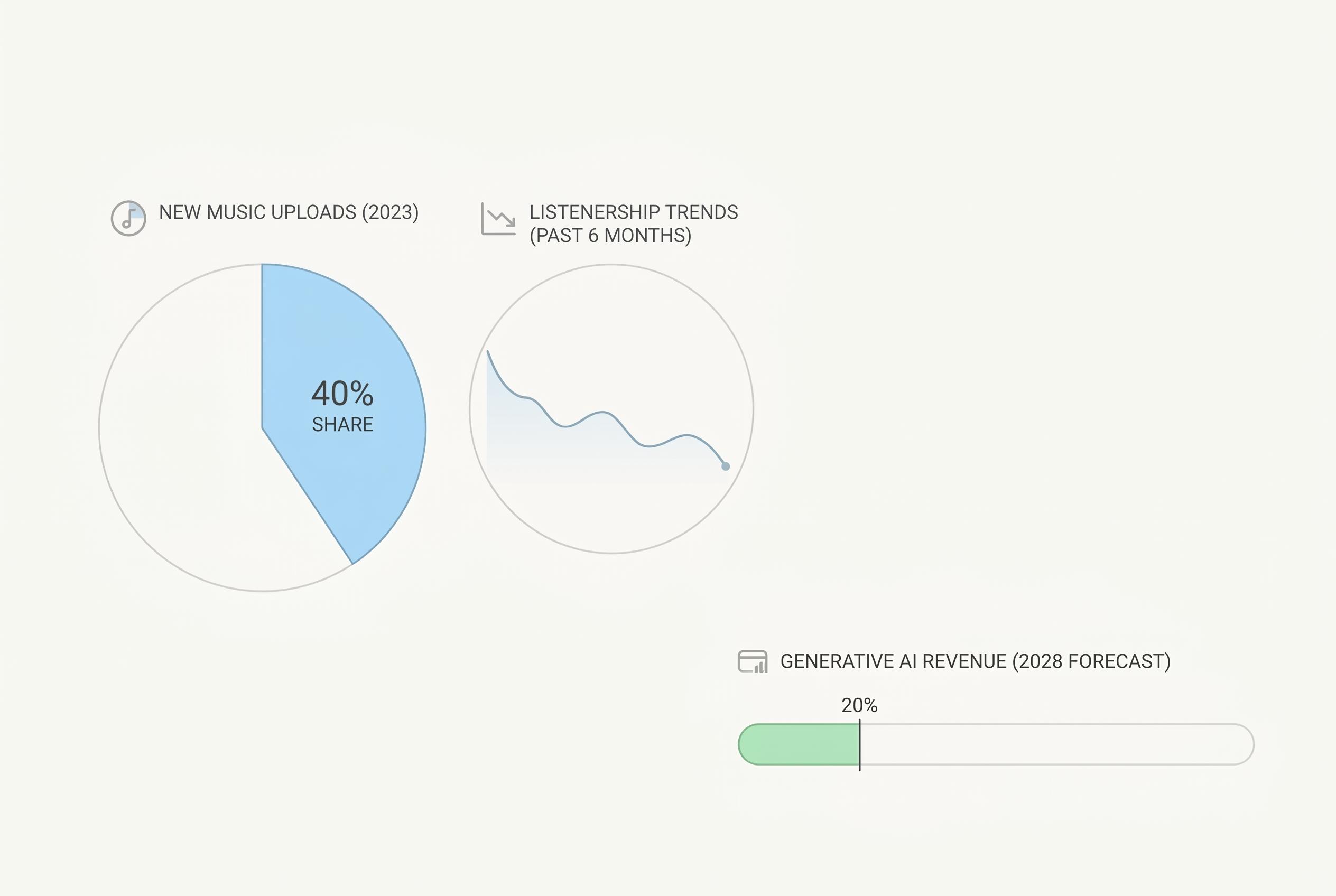
Deezer reveals that nearly half of all new music uploads are AI-generated, yet listenership remains low, prompting calls for transparency and safeguarding artists’ rights amid industry revenue predictions reaching 20% from generative AI by 2028.
AI-generated music is now flooding Deezer’s service, with the French streaming platform saying such tracks make up 44% of all new music uploaded each day, or close to 75,000 songs. That is a sharp rise from earlier this year, when Deezer said fully synthetic music accounted for 18% of daily uploads in April 2025 and about 28% by September, showing how quickly the category has expanded. Deezer has been tracking the trend with its detection tool, which it says was introduced in January 2025.
The company says the growth is not yet being matched by listening habits. AI-generated music still represents only about 1% to 3% of total streams on the platform, while Deezer says roughly 85% of those plays are fraudulent and are being demonetised. In January, the company said it had already identified and tagged more than 13.4 million AI tracks in 2025, with daily uploads averaging around 60,000 at that point.
Deezer has positioned itself as one of the more hard-line services on the issue. It says it excludes fully AI-generated tracks from recommendations and editorial playlists, and it has begun licensing its detection technology to other platforms. The company says the system can identify outputs from major generative music tools such as Suno and Udio, and can be adapted for other models if it has enough reference data.
The stakes are widening beyond streaming volumes. Deezer has cited industry research from CISAC warning that generative AI music could account for around 20% of streaming revenues and 60% of music library revenues by 2028, with creators potentially losing €10 billion over five years. Deezer chief executive Alexis Lanternier said the trend was no longer marginal and urged the wider sector to act on transparency and artist rights. The company also says consumer sentiment is broadly in favour of labelling, with most listeners preferring AI tracks to be clearly identified or kept out of charts alongside human-made songs.
Source Reference Map
Inspired by headline at: [1]
Sources by paragraph: - Paragraph 1: [2], [3] - Paragraph 2: [2], [5] - Paragraph 3: [2], [4] - Paragraph 4: [2], [5], [6]
Source: Noah Wire Services
Verification / Sources
- https://www.digit.fyi/ai-music-platforms/ - Please view link - unable to able to access data
- https://newsroom-deezer.com/2026/04/ai-generated-tracks-represent-44-of-new-uploaded-music/ - Deezer reports that AI-generated tracks now account for 44% of all new music uploaded daily, equating to nearly 75,000 AI tracks per day. Despite this surge, AI-generated music comprises only 1-3% of total streams, with 85% of these streams identified as fraudulent and subsequently demonetised. Deezer has implemented measures to detect and exclude AI-generated content from recommendations and editorial playlists, aiming to safeguard artists' rights and maintain transparency for listeners. The company has also made its AI detection technology available for licensing to promote industry-wide fairness.
- https://newsroom-deezer.com/2025/04/deezer-reveals-18-of-all-new-music-uploaded-to-streaming-is-fully-ai-generated/ - In April 2025, Deezer disclosed that 18% of all new music uploaded to its platform was fully AI-generated, marking a significant increase from 10% in January 2025. The company highlighted the rapid growth of AI-generated content and its commitment to addressing the challenges it poses to the music industry, including potential impacts on artists' rights and revenue. Deezer's AI detection tool was instrumental in identifying and managing this surge in AI-generated music, ensuring transparency and fairness for both artists and listeners.
- https://newsroom-deezer.com/2025/09/28-fully-ai-generated-music/ - By September 2025, Deezer reported that 28% of all music delivered to streaming was fully AI-generated, with over 30,000 AI-generated tracks uploaded daily. The company remained the only streaming provider to explicitly tag 100% AI-generated content and exclude it from recommendations, underscoring its commitment to fairness and transparency in the music industry. Deezer's proactive approach aimed to mitigate the impact of AI-generated music on artists and listeners, promoting a balanced and equitable streaming environment.
- https://newsroom-deezer.com/2026/01/ai-generated-music-deezer-selling-detection-tool/ - In January 2026, Deezer announced the commercial availability of its AI-music detection tool, developed over a year to identify and tag AI-generated tracks. The company reported that over 13.4 million AI tracks were detected and tagged in 2025, with daily uploads of AI-generated music averaging around 60,000 tracks, accounting for approximately 39% of all daily deliveries. Deezer also revealed that up to 85% of streams from AI-generated music were flagged as fraudulent and demonetised, highlighting the prevalence of fraudulent activities associated with AI-generated content.
- https://www.soundguys.com/deezer-ai-generated-music-150351/ - A December 2025 report from Deezer revealed that over 30% of all new music uploaded to its platform was fully AI-generated, amounting to more than 50,000 tracks daily. Despite the surge in synthetic content, it accounted for only 0.5% of actual streams, suggesting that listeners still prefer human-made music, even if they can't discern the difference. Deezer’s blind test studies across eight countries showed that 97% of people couldn't distinguish between AI and human-composed tracks. The rise of AI music raises industry concerns, including the need for clear labeling and potential impacts on artists' rights and revenue.
- https://www.techradar.com/audio/audio-streaming/deezer-says-nearly-half-of-all-new-music-uploaded-to-its-site-is-ai-generated-and-its-calling-on-spotify-and-other-streaming-giants-to-do-more-about-it - Deezer reports a dramatic increase in AI-generated music uploads on its platform, rising from just over 30% in December 2025 to 44% by April 2026—equivalent to about 75,000 tracks daily. To combat what it calls “AI slop,” Deezer has implemented strong measures, including AI-detection tools introduced in January 2025 that can tag fully AI-created music. The company has also stopped storing high-resolution versions of such tracks and demonetized those identified as fraudulent, with up to 85% of flagged streams considered fake. CEO Alexis Lanternier emphasized the success of their proactive strategy and invited competitors like Spotify, Apple Music, and Bandcamp to adopt similar safeguards. Deezer even made its AI detection system licensable to promote broader industry transparency. Users reportedly struggle to distinguish AI-generated music from human-made content, and concerns are growing about the exploitation of these tools to mimic artists and siphon revenue through fake streams.
Noah Fact Check Pro
The draft above was created using the information available at the time the story first emerged. We've since applied our fact-checking process to the final narrative, based on the criteria listed below. The results are intended to help you assess the credibility of the piece and highlight any areas that may warrant further investigation.
Freshness check
Score: 10
Notes: The article is current, published on April 20, 2026, and reports recent data from Deezer, indicating a significant increase in AI-generated music uploads.
Quotes check
Score: 10
Notes: The article includes direct quotes from Deezer's CEO, Alexis Lanternier, and references a survey conducted by Deezer, providing verifiable sources for the statements made.
Source reliability
Score: 10
Notes: The primary source is Deezer's official newsroom, a reputable and authoritative source for company announcements. The article also cites TechCrunch, a well-established technology news outlet, enhancing the credibility of the information presented.
Plausibility check
Score: 10
Notes: The claims about the rise in AI-generated music uploads and Deezer's measures to address this trend are consistent with industry observations and Deezer's previous statements, making them plausible and reasonable.
Overall assessment
Verdict (FAIL, OPEN, PASS): PASS
Confidence (LOW, MEDIUM, HIGH): HIGH
Summary: The article provides current, verifiable information from reliable sources about the increase in AI-generated music uploads on Deezer and the company's response to this trend. All checks have been passed with high confidence, indicating the content is accurate and trustworthy.