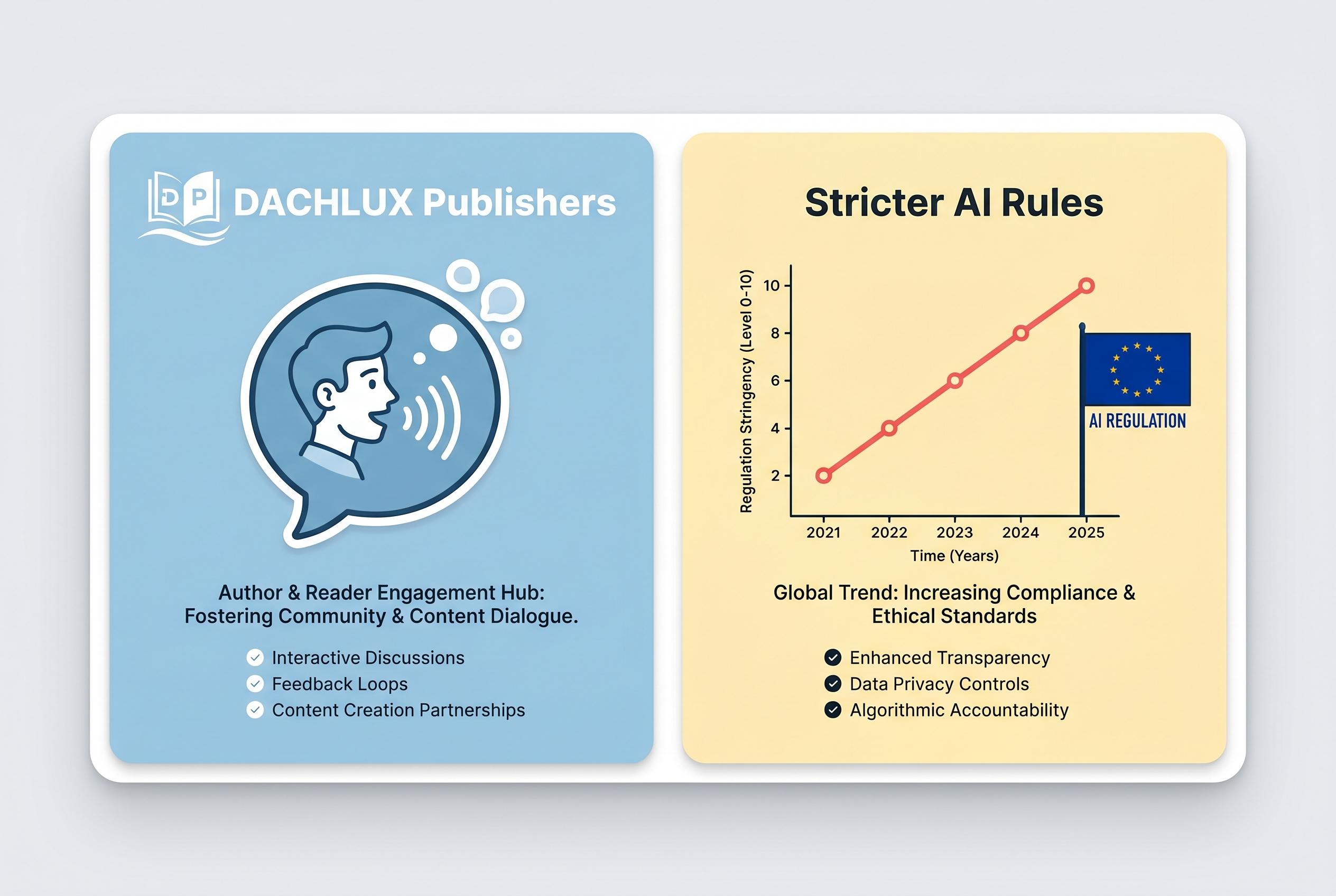
Publishers from Germany, Austria, Luxembourg and Switzerland have urged policymakers to implement new regulations on artificial intelligence and digital platforms, emphasising the need to safeguard independent journalism and ensure fair competition amidst growing market pressures.
Publishers from Germany, Austria, Luxembourg and Switzerland have used their latest DACHLUX meeting to press for tighter rules on how dominant platforms and artificial intelligence systems handle journalism, arguing that media diversity and the economic basis of independent news are under growing pressure. The so-called "Declaration of Luxembourg" places fair competition at the centre of the debate and calls for a regulatory framework that gives publishers stronger protection when their work is used online.
VÖZ president Maximilian Dasch, of Salzburger Nachrichten, said the issue goes to the heart of democratic life, warning that independent editorial media risk being pushed aside by powerful technology groups and the market distortions they create. The associations want policymakers, in Austria and across Europe, to move quickly on measures that would force greater transparency over algorithms, sources and ranking systems, while also giving media houses enforceable rights over their content and compensation when journalism is reused.
The declaration also argues that news organisations should be easier to find on digital platforms and that there must be clear limits on AI-generated content produced by dominant services. The publishers say the online advertising market is already structurally skewed against journalism, draining revenues that should support reporting and pushing media firms towards workable, data-based business models that are protected from platform practices.
Their concerns echo an earlier joint appeal last year, when publisher associations in the German-speaking countries warned that AI providers were training systems on journalistic content without consent, transparency or payment. In the latest statement, the groups add that public-interest archives must remain intact and that the right to be forgotten should not be used to rewrite history. Their conclusion is blunt: without independent journalism, fair competition and clearer rules for AI, democratic public debate will increasingly be shaped by a handful of global platforms.
Source Reference Map
Inspired by headline at: [1]
Sources by paragraph: - Paragraph 1: [2], [7] - Paragraph 2: [2] - Paragraph 3: [2], [5] - Paragraph 4: [3], [4], [5], [7]
Source: Noah Wire Services
Verification / Sources
- https://www.ots.at/presseaussendung/OTS_20260420_OTS0088/erklaerung-von-luxemburg-verlegerverbaende-fordern-klare-regeln-fuer-plattformen-ki-und-fairen-wettbewerb - Please view link - unable to able to access data
- https://www.ots.at/presseaussendung/OTS_20260420_OTS0088/erklaerung-von-luxemburg-verlegerverbaende-fordern-klare-regeln-fuer-plattformen-ki-und-fairen-wettbewerb - The 'Declaration of Luxembourg' was adopted at the DACHLUX meeting of publishers' associations from Germany, Austria, Luxembourg, and Switzerland. It focuses on protecting media diversity, ensuring fair competition, and securing the economic foundation of independent media. The declaration calls for clear and enforceable regulations for platforms and artificial intelligence (AI) in handling journalistic content. It emphasizes the need for transparency in algorithms, sources, and ranking logic, enforceable rights for media houses over their content, mandatory compensation for the use of journalistic content, non-discriminatory discoverability of journalistic offerings, and clear boundaries for AI-generated content from dominant platforms. The declaration also addresses the structural distortion of the digital advertising market and the necessity for data-based business models for media houses. It highlights the importance of preserving journalistic archives, especially on topics of public interest, and concludes that a functioning democratic public requires independent journalism, fair competition with platforms, and clear rules for the use of AI.
- https://www.netzwoche.ch/news/2025-04-11/verlegerverbaende-fordern-regeln-fuer-den-umgang-von-ki-mit-journalistischen-inhalten - Publisher associations from German-speaking countries have called for clear rules regarding the use of journalistic content by AI providers. In their 'Declaration of Zurich,' they outline five such rules. The associations express concern that AI models are being trained on journalistic content without the consent of rights holders, lacking transparency and compensation. They urge policymakers and AI providers to establish clearer guidelines for handling journalistic content by AI.
- https://www.gerichte-und-urteile.de/verlegerverbaende-fordern-klare-regeln-fuer-ki-anbieter/ - In their joint declaration 'The Declaration of Zurich,' publisher associations from Germany, Austria, Switzerland, and Luxembourg have made urgent demands to policymakers and AI providers. They highlight the issue that AI applications use journalistic content without the consent of rights holders, without transparency, and without compensation. Therefore, they call for binding rules for the handling of international AI platforms with journalistic content to protect the rights of publishers.
- https://www.zentralplus.ch/news/verlegerverbaende-fordern-ki-regeln-2760022/ - German-speaking publisher associations are demanding clear rules from technology companies and policymakers for AI providers when using media content. AI applications access media content, typically without the consent of rights holders, without transparency, and without compensation, according to the publisher associations from Switzerland, Germany, Austria, and Luxembourg in a joint 'Declaration of Zurich.' In their appeal, they demand that platform operators take responsibility. Without clear rules for how AI operators handle journalistic content, the journalism business model will erode.
- https://www.markt-kom.com/de/medien/medienpolitik/verlegerverbaende-fordern-regeln-fuer-den-umgang-von-ki-mit-journalistischen-inhalten/ - Publisher associations from German-speaking countries have called for clear rules regarding the use of journalistic content by AI providers. In their 'Declaration of Zurich,' they outline five such rules. The associations express concern that AI models are being trained on journalistic content without the consent of rights holders, lacking transparency and compensation. They urge policymakers and AI providers to establish clearer guidelines for handling journalistic content by AI.
- https://www.schweizermedien.ch/aktuelles/medienmitteilungen/2025/2025-04-11-erklaerung-von-zuerich-dachlux-verleger-fordern-klare-regeln-fuer-den-umgang-von-ki-mit-journalistischen-inhalten/ - Publisher associations from Germany, Austria, Switzerland, and Luxembourg have issued a joint declaration titled 'Declaration of Zurich,' demanding clear rules for the handling of AI with journalistic content. The declaration emphasizes the need for transparency, source attribution, compensation, responsibility, and equal treatment of media. AI applications often access media content without the consent of rights holders, without transparency, and without compensation, according to the publisher associations from Switzerland, Germany, Austria, and Luxembourg in a joint 'Declaration of Zurich.'
Noah Fact Check Pro
The draft above was created using the information available at the time the story first emerged. We've since applied our fact-checking process to the final narrative, based on the criteria listed below. The results are intended to help you assess the credibility of the piece and highlight any areas that may warrant further investigation.
Freshness check
Score: 8
Notes: The article references the "Declaration of Luxembourg" adopted at the DACHLUX meeting of publishers' associations from Germany, Austria, Luxembourg, and Switzerland. A similar declaration, the "Zurich Declaration," was adopted in April 2025, calling for clear rules for the use of AI with journalistic content. (markt-kom.com) The current article, dated April 20, 2026, appears to be a recent press release summarising the key points of the declaration. However, the exact publication date of the "Declaration of Luxembourg" is not specified, making it difficult to determine if the content is entirely new or recycled. The presence of a press release suggests a high freshness score, but the lack of a clear publication date for the declaration introduces some uncertainty.
Quotes check
Score: 7
Notes: The article includes a direct quote from VÖZ president Maximilian Dasch, stating, "Media companies of publishing origin make a valuable and indispensable contribution to the functioning of democracy and society." A search for this exact quote yields no earlier matches, indicating it may be original. However, without independent verification, the authenticity of the quote cannot be confirmed. The absence of online matches raises concerns about the verifiability of the quote.
Source reliability
Score: 6
Notes: The article originates from OTS, the Austrian Press Agency, which is a reputable news agency. However, the content appears to be a press release summarising the "Declaration of Luxembourg." Press releases are often promotional and may lack independent verification. The reliance on a press release as the primary source raises concerns about the independence and objectivity of the information presented.
Plausibility check
Score: 7
Notes: The article discusses the "Declaration of Luxembourg," which calls for clear and enforceable frameworks for how platforms and AI systems handle journalistic content. This aligns with ongoing discussions about AI's impact on journalism and the need for regulation. However, the lack of independent verification and the reliance on a press release as the primary source introduce uncertainties about the accuracy and completeness of the information.
Overall assessment
Verdict (FAIL, OPEN, PASS): FAIL
Confidence (LOW, MEDIUM, HIGH): MEDIUM
Summary: The article is a press release summarising the "Declaration of Luxembourg," which calls for clear and enforceable frameworks for how platforms and AI systems handle journalistic content. While the content is accessible without paywall restrictions, the reliance on a press release as the primary source raises concerns about the independence and objectivity of the information presented. The lack of independent verification and the absence of online matches for the quoted statements further diminish the reliability of the content.