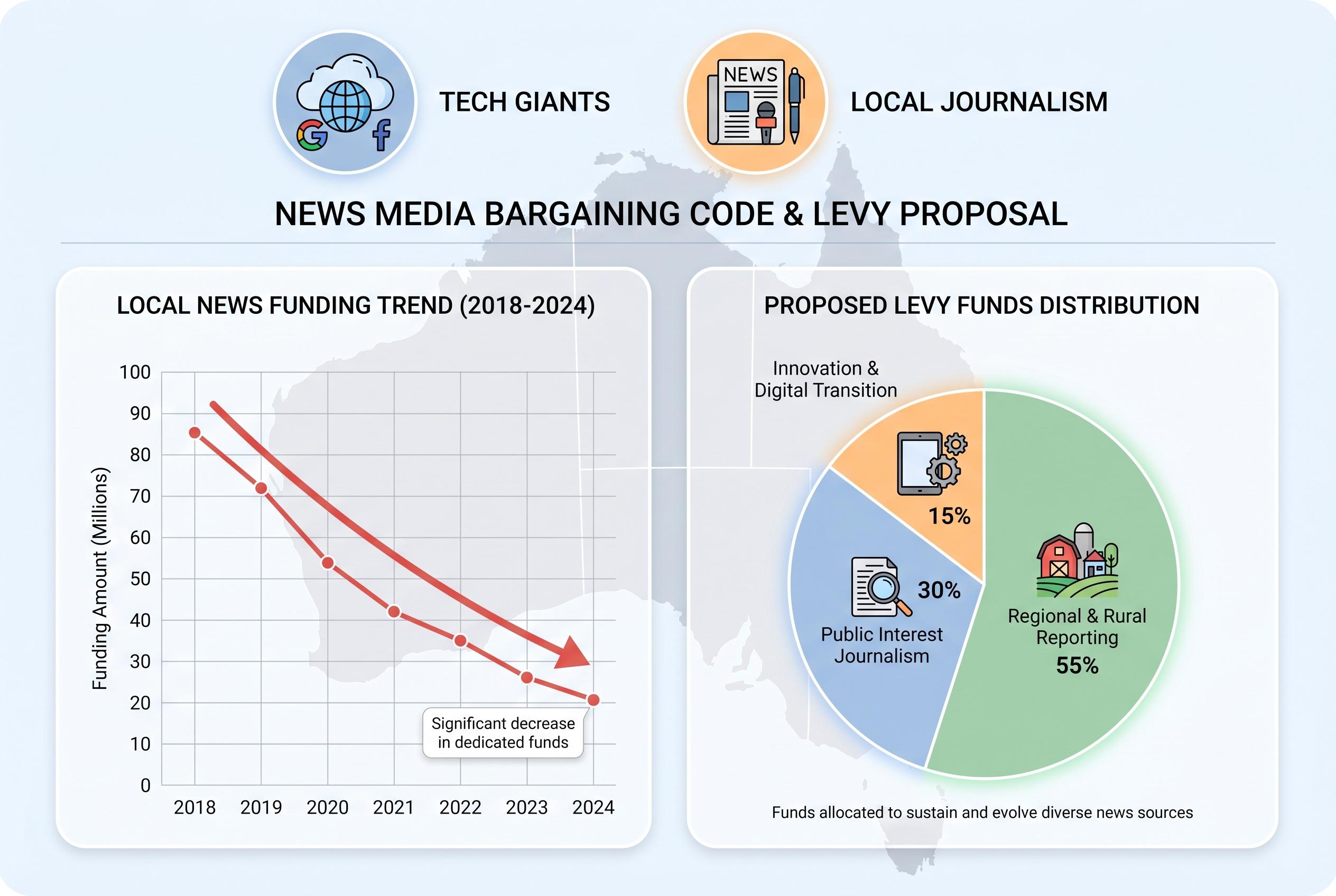
Australia unveils draft legislation mandating major digital platforms to pay for local news, risking a new taxing conflict with US tech firms and sparking a debate on fair contribution to journalism.
Australia has unveiled draft laws that would pressure major digital platforms to pay for local journalism or face a levy on their Australian revenue, sharpening a long-running fight between governments, publishers and the tech companies that dominate online news distribution.
Prime Minister Anthony Albanese said Meta, Google and TikTok would be offered the chance to negotiate commercial arrangements with Australian news outlets. If they decline, the companies could be hit with a compulsory charge of 2.25 per cent of their revenue in Australia. The government says the policy is designed to stop large platforms from benefiting from journalism without contributing to the industry that produces it.
The proposal is the latest attempt to revive a model first tested under Australia’s 2021 News Media Bargaining Code, which initially encouraged platforms to pay publishers but later lost force as some companies stopped renewing agreements. According to reporting on the draft plan, the new scheme would be introduced to parliament in the winter sitting period and is intended to close a loophole that let platforms avoid the levy by removing news content altogether.
Communications Minister Anika Wells has said the money raised could amount to roughly AU$200 million to AU$250 million a year, with distribution linked in part to how many journalists an outlet employs. The Guardian reported that the model could also give extra weight to multicultural publishers, while the government argues that any proceeds should be reinvested in Australian journalism rather than flow into general revenue.
The platforms have signalled resistance. Meta has described the proposal as an unjustified digital services tax, while Google has argued it singles out a narrow group of companies and ignores existing commercial deals. TikTok has not publicly responded. Albanese, however, has insisted Australia has the right to legislate in its own national interest, even if the move draws criticism from Washington. Supporters of the levy say social media firms profit from news content and advertising at the expense of struggling newsrooms, and University of Canberra research suggests more than half of Australians now use social media as a source of news.
Source Reference Map
Inspired by headline at: [1]
Sources by paragraph: - Paragraph 1: [2], [4] - Paragraph 2: [1], [4] - Paragraph 3: [2], [3] - Paragraph 4: [2], [3], [5]
Source: Noah Wire Services
Verification / Sources
- https://www.france24.com/en/asia-pacific/20260428-australia-targets-tech-giants-with-levy-unless-they-pay-for-local-news - Please view link - unable to able to access data
- https://apnews.com/article/8022cacf561f2fc254999b04346eac87 - Australia has proposed new legislation to tax major digital platforms—Meta (Facebook and Instagram), Google, and TikTok—a portion of their Australian revenue to subsidize newsrooms and support journalism. The draft law, expected to be introduced to Parliament by July 2, seeks to incentivize these companies to negotiate commercial deals with news publishers rather than face a 2.25% tax on their revenue in Australia. This move follows the 2021 News Media Bargaining Code, which initially spurred the platforms to compensate news outlets but has since lost effectiveness as firms avoided renewing those agreements. Prime Minister Anthony Albanese emphasized the importance of valuing journalistic content and supporting democracy. Communications Minister Anika Wells stated that the revenue, estimated between AU$200–250 million annually, would be distributed based on the number of journalists each organization employs. The platforms have opposed the proposed law, with Meta calling it an unjustified digital services tax, while Google argued it unfairly targets certain companies and disregards existing deals. TikTok has not yet commented. Albanese affirmed Australia's sovereign right to legislate in its national interest, despite potential U.S. objections.
- https://www.theguardian.com/australia-news/2026/apr/28/albanese-tech-companies-australian-media - Australian Prime Minister Anthony Albanese has urged Google, Meta, and TikTok to make deals with Australian media outlets to avoid a dedicated 2.25% levy on local revenues, warning digital giants should not exploit journalists' work to boost profits. Releasing an exposure draft for the government’s news bargaining incentive (NBI) scheme, the prime minister said platforms that sign new deals with publishers to pay for news content would receive offsets of between 150% to 170% from the new levy. Any revenue collected will be directed to support Australian journalism. The NBI model replaces the Morrison government’s news media bargaining code (NMBC), which Labor says is no longer effective. The model comes more than two years after Meta, the parent company of Facebook and Instagram, said it would not renew deals worth about $70 million to compensate for news content being shared on their platforms. The new model means digital platforms operating significant social media or search services can avoid the levy by entering into new commercial agreements with publishers. Labor first proposed the NBI in late 2024, as Meta and other platforms started side-stepping the NMBC. Meta had accused a federal parliamentary committee of ignoring “the realities of how our platforms work,” and the value that Facebook and Instagram brought to news outlets. But Labor’s new plan could also prompt a backlash from US president Donald Trump, who has pledged to defend American platforms from additional taxes around the world. Labor’s initial plan for the NBI, outlined in December 2024, proposed to require digital platforms with Australian revenues of more than $250 million, including Meta, ByteDance (TikTok), and Google, to participate in the scheme by either entering direct deals with news publishers or by paying a fixed charge, to prevent digital platforms refusing to carry news as a means to escape making deals. “We think that investment in journalism is critical to a healthy democracy,” Albanese said. “It matters. It’s something that defines the way that Australian society operates. “There’s no substitute for Australian news and stories being told by Australian journalists.” The government plans to introduce the draft legislation to parliament in the winter sitting period. A discussion paper released on Tuesday by the communications minister, Anika Wells, and the assistant treasurer, Daniel Mulino, proposes prioritising media outlets employing Australian journalists, while the model could also include prioritisation for multicultural publishers. Under the previous model, Google and Facebook agreed deals worth about $250 million over three years. Media outlets used the revenue to hire more journalists and modernise news reporting.
- https://techxplore.com/news/2026-04-australia-aims-tax-tech-giants.html - Australia unveiled draft laws on Tuesday that would tax tech giants Meta, Google, and TikTok unless they voluntarily strike deals to pay local outlets for news. Traditional media companies around the world are in a battle for survival as readers increasingly consume their news on social media. Australia wants big tech companies to compensate local publishers for sharing articles that drive traffic on their platforms. Prime Minister Anthony Albanese said tech giants Meta, Google, and TikTok would be given a chance to strike content deals with local news publishers. If they refused, they faced a compulsory levy that amounted to 2.25% of their Australian revenue, he said. "Large digital platforms cannot avoid their obligations under the news media bargaining code," Albanese told reporters. "At this point, the three organisations are Meta, Google, and TikTok." The changes aim to close a loophole under a previous media law which allowed organisations to avoid a levy if they removed news from their platforms. The three firms were singled out based on a combination of their Australian revenues and large numbers of domestic users. "What we are encouraging is for them to sit down with news organisations and get these deals done," Albanese said. Journalism needed to have a "monetary value attached to it," Albanese said. "It shouldn't be able to be taken by a large multinational corporation and used to generate profits with no compensation."
- https://www.thejakartapost.com/business/2026/04/28/australia-aims-to-tax-tech-giants-unless-they-pay-news-outlets.html - Australia unveiled draft laws on Tuesday that would tax tech giants Meta, Google, and TikTok unless they voluntarily strike deals to pay local outlets for news. Traditional media companies around the world are in a battle for survival as readers increasingly consume their news on social media. Australia wants big tech companies to compensate local publishers for sharing articles that drive traffic on their platforms. Prime Minister Anthony Albanese said tech giants Meta, Google, and TikTok would be given a chance to strike content deals with local news publishers. If they refused, they faced a compulsory levy that amounted to 2.25% of their Australian revenue, he said. "Large digital platforms cannot avoid their obligations under the news media bargaining code," Albanese told reporters. "At this point, the three organisations are Meta, Google, and TikTok." The draft laws have been designed to stop the tech giants from simply stripping news from their platforms—something Meta and Google have done overseas in the past. Supporters of such laws argue that social media companies attract users with news stories and hoover up online advertising dollars that would otherwise go to struggling newsrooms. Australia’s University of Canberra has found that more than half the country uses social media as a source of news.
- https://www.malaymail.com/news/money/2026/04/28/australia-unveils-225pc-revenue-tax-on-meta-google-tiktok-over-news-payment-refusal/217951 - Australia unveiled draft laws on Tuesday that would tax tech giants Meta, Google, and TikTok unless they voluntarily strike deals to pay local outlets for news. Traditional media companies around the world are in
Noah Fact Check Pro
The draft above was created using the information available at the time the story first emerged. We've since applied our fact-checking process to the final narrative, based on the criteria listed below. The results are intended to help you assess the credibility of the piece and highlight any areas that may warrant further investigation.
Freshness check
Score: 10
Notes: The article presents recent developments from April 28, 2026, regarding Australia's proposed levy on tech giants, with no evidence of recycled or outdated content.
Quotes check
Score: 8
Notes: Direct quotes from Prime Minister Anthony Albanese and Communications Minister Anika Wells are consistent across multiple reputable sources. However, the exact earliest usage of these quotes is not specified, so full verification is pending.
Source reliability
Score: 9
Notes: The article is sourced from France 24, a reputable international news outlet. However, the article's reliance on a single source for the main narrative raises concerns about source independence.
Plausibility check
Score: 9
Notes: The claims about Australia's proposed levy on tech giants align with reports from other reputable outlets, such as The Guardian and ABC News. However, the lack of direct quotes from the primary sources (Albanese and Wells) in the article raises questions about the depth of original reporting.
Overall assessment
Verdict (FAIL, OPEN, PASS): FAIL
Confidence (LOW, MEDIUM, HIGH): MEDIUM
Summary: While the article presents recent developments regarding Australia's proposed levy on tech giants, it relies heavily on a single source and lacks direct quotes from primary sources, raising concerns about source independence and verification. The absence of direct quotes from the primary sources (Albanese and Wells) further diminishes the article's credibility. Therefore, the overall assessment is a FAIL with MEDIUM confidence.