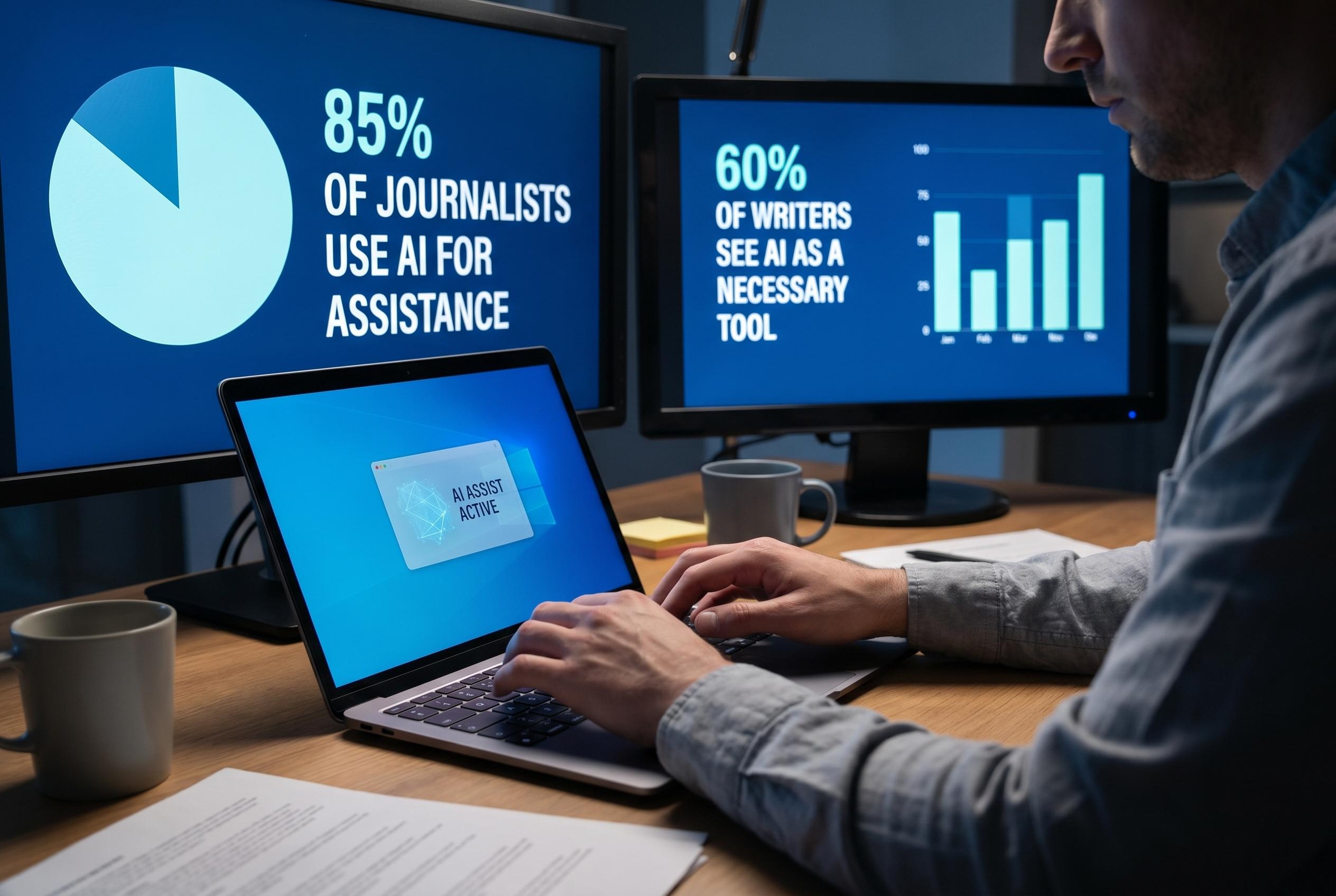
Growing recognition of AI's role in expanding access and supporting professional writing calls for transparent and nuanced editorial policies, avoiding suspicion and rewarding depth over blandness.
Artificial intelligence is reshaping professional writing less as a replacement for human thought than as a way to widen access to it. What used to be a high-friction task for many professionals , turning expertise into polished prose , is becoming easier to manage, and that matters for people whose ideas were never the problem. The real shift is not merely faster drafting, but lower barriers to participation.
That is why the growing habit of treating any AI use as suspect is so misguided. Writing has always depended on support: editors, proofreaders, and specialist communicators have long helped good ideas reach publication. AI now performs a similar function for many users, but at a scale and cost that were previously unavailable. Viewed properly, it is not a shortcut around authorship but a tool that expands who can contribute.
The argument becomes even stronger when cognitive load is taken seriously. Writing is demanding even for experienced professionals, and for people with dyslexia, ADHD, anxiety, burnout, or for those writing in a second language, the strain of arranging, revising and polishing ideas can be substantial. In that context, AI can act like assistive technology, helping to remove mechanical obstacles without displacing judgment or intent. McKinsey has described this broader pattern as AI amplifying human capability rather than diminishing it.
Editorial systems have not always adapted to that reality with nuance. Some publications have reacted to the rise of AI by shifting from governance to suspicion, using detection tools and blunt disclosure rules in ways that can confuse refinement with fabrication. Stanford’s AI policy and guidance from responsible-AI advocates such as BCG both stress the need for transparency, accountability and contextual judgment rather than simple technical policing. The problem is not that standards are too high; it is that they are sometimes enforced without sufficient understanding of how modern writing is actually produced.
That creates a particular irony. Analytical, experience-based writing is often the work most likely to show structure, voice and a clear argument, which can make it look more “artificial” to crude detection systems. Meanwhile, shallow, templated content can slip through because it leaves little trace of thinking at all. In practice, that means editorial processes may end up penalising depth while rewarding blandness.
This is why mature editorial practice increasingly depends on disclosure rather than guesswork. Publications such as Harvard Business Review, MIT Sloan Management Review, Fortune, Forbes and Axios have all moved towards clearer expectations around how AI is used and when it should be disclosed. The logic is straightforward: the writer remains responsible for the ideas, the evidence and the consequences, while AI is treated as a tool for drafting, clarification or limited sense-checking. COPE’s guidance on authorship and AI tools points in the same direction.
For contributors, the stakes are not abstract. When editorial decisions feel inconsistent or opaque, trust erodes quickly, and skilled writers begin to withdraw. Global contributors, non-native English speakers and neurodivergent professionals are often the first to feel that pressure, because they are more likely to rely on language support to bridge real barriers. At the same time, it is easy for publications to miss the larger cost: the loss of serious, original voices in favour of safer and more interchangeable copy.
The healthiest response is not panic, but professionalism. That means keeping records, insisting on transparency, building direct audiences and refusing to let one publication define a contributor’s value. It also means recognising that visibility is no longer controlled by editors alone. Newsletters, personal platforms, communities and professional networks all give writers alternative routes to reach readers. A publication can amplify a voice, but it cannot own it.
The central question, then, is not whether AI touched a piece of writing. It is whether the thinking is original, accountable and worth engaging with. According to the argument made across the cited material, editorial rigour should be measured by judgement and verification, not by fear of tools that are already part of professional practice. When publications understand that distinction, they protect standards more effectively than when they confuse assistance with authorship.
Source Reference Map
Inspired by headline at: [1]
Sources by paragraph: - Paragraph 1: [2], [5] - Paragraph 2: [2], [6] - Paragraph 3: [3], [4], [5] - Paragraph 4: [6], [7] - Paragraph 5: [2], [6] - Paragraph 6: [6], [7] - Paragraph 7: [2], [4] - Paragraph 8: [2], [5], [6]
Source: Noah Wire Services
Verification / Sources
- https://www.eglobalis.com/the-new-editorial-risk-confusing-ai-assistance-with-ai-authorship/ - Please view link - unable to able to access data
- https://www.eglobalis.com/the-new-editorial-risk-confusing-ai-assistance-with-ai-authorship/ - This article discusses the evolving role of artificial intelligence (AI) in professional writing, emphasizing that AI should be viewed as an assistive tool rather than a shortcut. It highlights how AI enables individuals to participate in professional discourse by reducing the cognitive load associated with writing, thereby democratizing access to publishing. The piece also addresses the challenges faced by editorial teams in distinguishing between AI assistance and authorship, advocating for a nuanced understanding of AI's role in content creation.
- https://www.forbes.com/sites/jodiecook/2025/12/11/the-ai-voice-shortcut-that-unlocks-serious-productivity-gains/ - This Forbes article explores how AI-powered voice dictation is revolutionizing productivity by allowing users to convert speech into text more efficiently than typing. It discusses the benefits of using voice for content creation, including faster idea capture and improved posture. The piece also highlights the role of AI in refining output, suggesting that AI serves as a tool to enhance human productivity rather than replace it.
- https://www.forbes.com/councils/forbestechcouncil/2026/01/07/voice-modality-the-next-frontier-in-ai-and-workflow/ - This article examines the integration of voice modality in AI and its impact on workflow efficiency. It discusses how voice interfaces can serve as force multipliers, significantly increasing productivity by enabling hands-free operation. The piece also highlights the inclusion benefits of voice technology, particularly in overcoming language barriers within global teams, and suggests that voice will be a primary interface in future consumer AI products.
- https://www.mckinsey.com/capabilities/tech-and-ai/our-insights/superagency-in-the-workplace-empowering-people-to-unlock-ais-full-potential-at-work - This McKinsey article discusses the concept of 'superagency' in the workplace, where AI tools empower individuals to enhance their capabilities. It emphasizes that AI should be viewed as a tool to amplify human potential rather than a shortcut, enabling professionals to scale their expertise and improve decision-making processes. The piece advocates for responsible and ethical use of AI to unlock its full potential in the workplace.
- https://www.sup.org/about/ai-policy - This page from Stanford University's Human-Centered AI Institute outlines the institution's policy on AI, emphasizing the importance of understanding and responsibly integrating AI technologies. It discusses the ethical considerations of AI use, particularly in content creation, and advocates for transparency and accountability in AI-assisted work. The policy highlights the need for a nuanced approach to AI, distinguishing between assistance and authorship.
- https://www.bcg.com/capabilities/artificial-intelligence/responsible-ai - This page from Boston Consulting Group (BCG) focuses on responsible AI practices, emphasizing the importance of ethical considerations in AI deployment. It discusses how AI can be used to enhance human capabilities and decision-making processes, aligning with the view that AI should serve as an assistive tool rather than a shortcut. The piece also addresses the need for transparency and accountability in AI applications.
Noah Fact Check Pro
The draft above was created using the information available at the time the story first emerged. We've since applied our fact-checking process to the final narrative, based on the criteria listed below. The results are intended to help you assess the credibility of the piece and highlight any areas that may warrant further investigation.
Freshness check
Score: 8
Notes: The article was published on eGlobalis on April 20, 2026. A search for similar narratives yielded no substantially similar content from the past seven days, indicating originality. However, the topic of AI's role in professional writing has been discussed in various contexts, which may lead to thematic similarities.
Quotes check
Score: 7
Notes: The article does not contain direct quotes. It references ideas from McKinsey and BCG, but these are paraphrased and not directly quoted. The lack of direct quotes reduces the risk of reused content but also means that the specific sources cannot be independently verified.
Source reliability
Score: 6
Notes: eGlobalis is a niche publication focusing on AI and customer experience. While it provides in-depth analyses, its reach and recognition are limited compared to major news organisations. The article references reputable sources like McKinsey and BCG, but these are not directly accessible for verification.
Plausibility check
Score: 7
Notes: The claims about AI's role in professional writing and the potential confusion between AI assistance and authorship are plausible and align with ongoing discussions in the field. However, the article's reliance on paraphrased ideas from McKinsey and BCG without direct citations makes independent verification challenging.
Overall assessment
Verdict (FAIL, OPEN, PASS): OPEN
Confidence (LOW, MEDIUM, HIGH): MEDIUM
Summary: The article presents a timely discussion on the role of AI in professional writing, highlighting the potential confusion between AI assistance and authorship. While the content is original and the claims are plausible, the lack of direct citations and the inability to independently verify the referenced ideas from McKinsey and BCG reduce the overall confidence in the article's accuracy. The source's limited reach further contributes to this uncertainty. Therefore, the overall assessment is OPEN with MEDIUM confidence.